
Today I'm once again circling the hot AI porridge. Because, as I started doing in the previous newsletters, I want to set the context and, above all, define the problem more precisely. You can only develop good solutions once you've identified the problem correctly. Over the course of my career I've noticed very often that my clients defined the symptoms as the problem, and we first had to work together to diagnose the actual causes. Where and how we can use AI tools sensibly depends on the problem we want to solve.
So let me first return to the root cause of many problems of our time, an era labelled the “Zettabyte Era”: too much information. In the newsletter's cliffhanger I asked the question “What is ‘precise, well-prepared and usable information’?” Why this question matters so much has to do with a rampant symptom of this “zettabyte problem”, namely
how much of our information intake is actually distraction?
The modern information landscape has fundamentally changed how people consume and process information. Current findings suggest that a considerable share of our daily information intake is distraction rather than meaningful use. Studies show that almost 50% of our time is spent in a distracted state, while the average person spends over 7 hours a day in front of screens, much of it on unproductive activities. At work, employees waste 30 to 90 minutes a day on distracting information sources such as social media and personal communication, while 80% of workers can't get through a single hour without interruption. Educational institutions reveal similar patterns: two thirds of students report being distracted by digital devices, which correlates directly with poorer academic performance. This pervasive distraction epidemic reflects systemic challenges of the attention economy, in which information overload affects 80% of workers worldwide and causes measurable losses in productivity, concentration and decision-making ability.
Statistics and scale of digital distraction
The scale of information distraction becomes clear when you analyse screen time and device use across different population groups. Americans spend an average of 7 hours and 4 minutes a day in front of screens, above the global average of 6 hours and 40 minutes. That's an increase of almost 50 minutes since 2013, a sign of accelerating digitalisation. Gen Z shows particularly intense usage patterns with around 9 hours of daily screen time, which points to higher distraction risks among younger demographics.
The composition of this screen time reveals problematic patterns. Globally, 2 hours and 51 minutes go to computers and 3 hours and 46 minutes to mobile devices, the latter marked by fragmentation and interruptions. Research shows that 90% of people consider their smartphone the biggest distraction, while teenagers receive a median of 273 notifications a day, almost a quarter of them during school hours.
International differences underline cultural influences on distraction patterns: South Africans spend the most time in front of screens at 10 hours and 46 minutes, while the Japanese clock in at just 3 hours a day. These disparities suggest that distraction levels aren't uniform but depend on access to technology, cultural norms and lifestyles.
The trend towards rising digital consumption continues unabated: screen time already accounts for 40% of waking hours globally. Children aged 8 to 18 spend an average of 7.5 hours a day in front of screens, evidence of distraction patterns established early. All of this makes it increasingly hard to tell meaningful information consumption apart from mere distraction.
Distraction at work
Professional environments provide clear evidence of how information consumption undermines productive work. Knowledge workers lose 30 to 90 minutes a day to non-work activities, which adds up to 720 working hours per employee a year. Communication technologies, indispensable as they are, contribute heavily to distraction: employees check their email 74 times a day on average and spend 2.6 hours just managing it. Messaging apps cause 157 lost hours a year, making them the biggest productivity killer.
Fragmented attention is everywhere: 80% of employees can't work undisturbed for an hour, and 67% check messages more than ten times a day. On top of that, workers need 25 minutes after an interruption to get back into the flow, which costs 127 recovery hours a year. The use of numerous information sources (26% of US workers use eleven or more tools daily) makes the overload even worse.
Education and information consumption
Educational institutions show how information patterns affect learning and cognition. In US schools, two thirds of students are distracted by digital devices in maths class, while 54% are distracted by classmates. Globally, 65% of OECD students report digital distraction, which translates into 15 points lower performance, a loss of three quarters of a school year.
Despite 1:1 computing environments in many schools, preventing distraction remains difficult. Phone bans often fail: 29% of students use smartphones several times a day despite a ban, and 61% are distracted while studying at home. These patterns underline that behavioural change is just as necessary as policy measures.
Information overload and its consequences
Information overload affects 80% of workers worldwide and causes stress for 76% of US employees. The volume of data will grow to 180 zettabytes by 2025, exceeding human processing capacity. News avoidance is a coping mechanism: 39% avoid the news sometimes or often, and the feeling of overload has risen by 11 percentage points since 2019.
A low signal-to-noise ratio is the hallmark of overload: useful information drowns in irrelevant “noise”, leading to “information pollution” and worse decisions. This state is amplified by easy access to information, exponential data growth and uncontrolled dissemination.
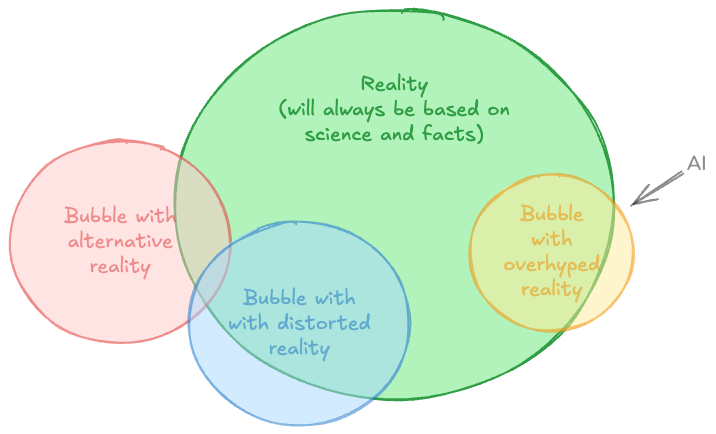
I had already mentioned another, bigger problem, because it's highly relevant socially and politically: many people are overwhelmed by this flood of data and retreat into bubbles, where they try to find a little bit of “digital wellbeing”, regardless of the quality, relevance and accuracy of the information they find in those bubbles*.
The economics of attention
In the attention economy, human concentration becomes a scarce resource that platforms and companies fight over. Although digital platforms contribute trillions to GDP, the costs of lost productivity and cognitive impairment go uncounted.
Social acceleration shows up in shorter attention spans: the time hashtags spent in the Twitter top 50 dropped from 17.5 to 11.9 hours (2013–2016). Platform designs built on algorithms, notifications and gamification maximise time spent, which causes individual and societal costs in the long run. What social media platforms care about is maximising that dwell time with ever more clickbait. Guaranteeing information quality is not on the agenda.
All this evidence shows that a large part of today's information consumption is mostly distraction. With 50% of time spent distracted and over 7 hours of screen use a day, society faces the challenge of separating the valuable from the trivial. Workplace data shows 720–1,000 lost hours a year, while educational institutions lose three quarters of a school year to distraction.
The transformation of information consumption reflects systemic change: the attention economy, which prioritises “engagement” over accuracy, overloads 80% of workers. Solutions require policy measures, a technological reorientation and a culture that values sustained attention. Without holistic approaches, the share of distracting information intake will keep rising, with consequences for productivity, learning and human development.
Can technology, and AI in particular, help us solve this problem?
Yes, but only if we work on our “digital wellbeing” and, above all, stop mixing up the debate about the drill with the debate about the hole.
Right, in the next newsletter I'll be talking more about the drill again, meaning AI tools. Stay tuned ... ;)
Live long and prosper 😉🖖
Postscript: you'll find the sources for the data cited in this newsletter here