
The zettabyte era: how exponential data growth is testing our society
Over the past five decades, the world's data volume has multiplied at an unprecedented pace. What started in the 1970s with megabytes and gigabytes has turned into a full-blown data explosion: global data volume has grown exponentially (do keep an eye on the y-axis of the chart below 😉 ). According to forecasts, the volume of data generated worldwide will reach around 394 zettabytes in 2028, a number that is hard to even wrap your head around.
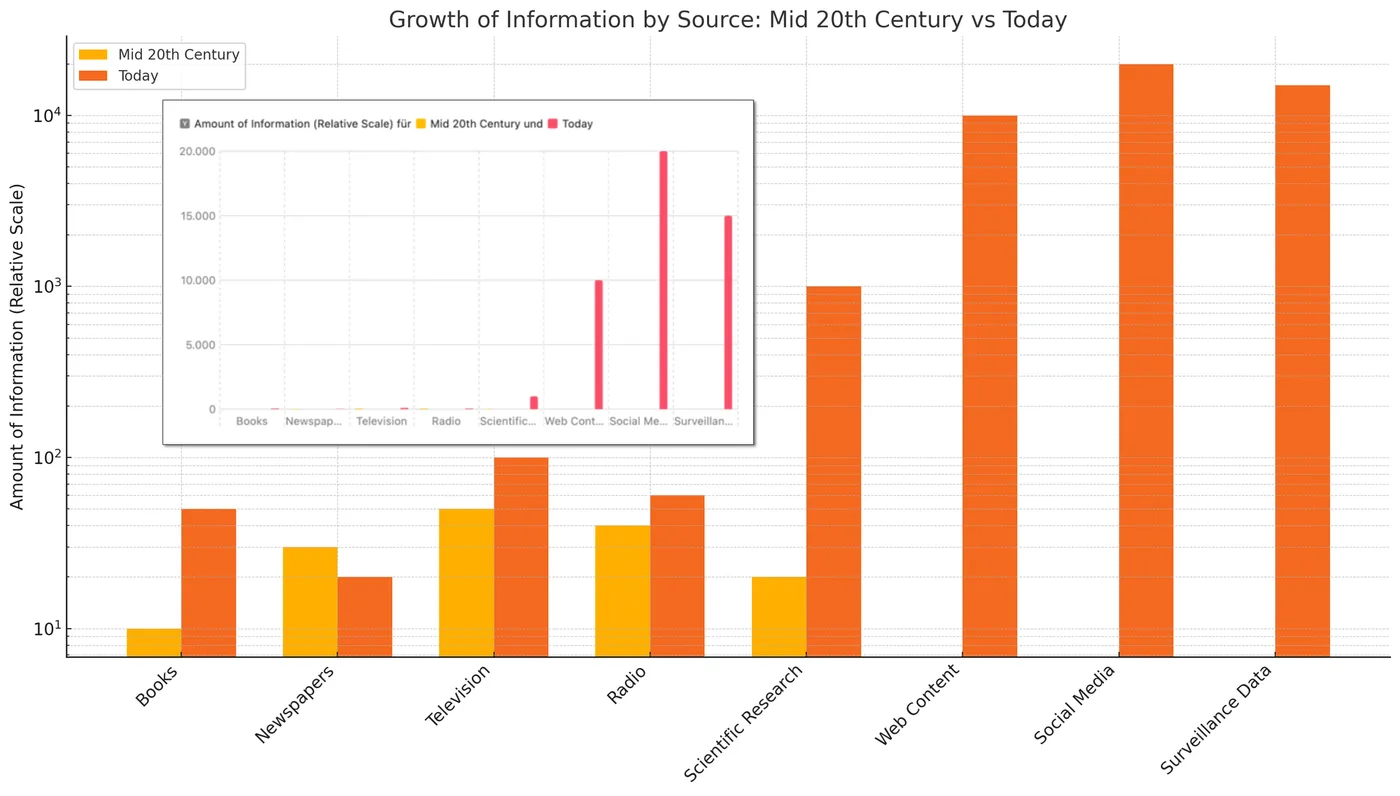
So what is a zettabyte?
A zettabyte is one sextillion bytes. That's a number with 21 zeros (for comparison, 1 gigabyte has 9). These gigantic amounts of data come from the digitalisation of every area of life, from social media to industrial plants to scientific measurement data*.
Crushed by data
With this exponential growth in data, companies, institutions and private individuals alike face an enormous challenge: more and more people and organisations feel downright crushed by the sheer mass of data. More than half of all companies say that their data volume is growing so fast that they can barely keep up. Managing, storing and analysing these mountains of data is becoming ever more complex and resource-hungry.
The trouble with unstructured data
The problem gets even worse because most of this data is unstructured: an estimated 80–90 % of all business data exists in unstructured form. That includes emails, images, videos, sensor recordings, chat logs and much more. This data can't simply be filed away in classic databases like mySQL, Oracle or Postgres, and it is hard to search, analyse or put to good use with conventional methods. The fact is that despite massive IT investments, many companies struggle to manage this mountain of data, let alone get any value out of it.
One of the biggest challenges of our time
Exponential data growth and the dominance of unstructured data are among the biggest societal challenges of our time. Technology and storage space are only part of it. The real question is whether we can extract valuable, or rather correct, insights from the flood, drive innovation, and at the same time guarantee data protection, security and sustainability. Many people are overwhelmed by this data deluge and retreat into bubbles, where they try to find a little bit of "Digital Wellbeing", regardless of the quality and accuracy of the information they find in there. And we can already see the political consequences of these bubbles quite clearly, as they distort the sense of reality of those who live inside them.
With LLMs, we finally have a technology that tackles this problem.
Large Language Models (LLMs), the foundation of today's AI tools such as ChatGPT or Gemini, represent a decisive breakthrough in dealing with the exponentially growing volume of unstructured data. Where classic IT methods often hit the limits of what they can do, LLMs offer, for the first time, tools to process large, unstructured datasets efficiently and meaningfully.
LLMs are specialised in understanding, analysing and generating natural language. They have been trained on billions of text examples, which enables them to recognise patterns, connections and meaning even in complex and heterogeneous text data. That makes it possible to automatically search, classify, extract and interpret unstructured data such as emails, social media posts, reports or scientific articles.
Specifically, LLMs can:
- Turn text and media data into structured information, for example by detecting and extracting entities, topics or sentiment.
- Filter relevant information out of large datasets and so make the information flood manageable.
- Combine and analyse different media, data sources and formats, something classic methods often can't do.
- Understand semantic relationships, so they can grasp the context and meaning of texts. That's a decisive advantage when analysing unstructured data.
For the first time, LLMs open up the possibility of extracting valuable knowledge from the overwhelming mass of unstructured data and making that data usable for decision-making, innovation and automation. That makes them a key tool for tackling the biggest challenge of the digital society.
But LLMs are "data accelerators" themselves
Paradoxically, large language models (LLMs) like ChatGPT and image generators like Midjourney also contribute to the zettabyte problem. On the one hand, they help us handle unstructured data better; on the other, they dramatically accelerate the creation of new content. Within seconds, AI automatically churns out texts, images, videos or synthetic voices, which in turn get stored, shared and archived. So data volume is multiplying not just by human hand but increasingly by machines. We now have a data avalanche that keeps accelerating itself. Another interesting side effect: we will soon have more "machine content" than "human content". What that means for LLMs when they're fed their own output isn't entirely clear yet.
That said: “It's the hole, not the drill” – focusing on the real value of data
In this debate, though, we should never confuse the drill with the hole, and this is a textbook example of the principle: “People don't want a product, they want the result.” Or, as Harvard professor Theodore Levitt put it: “People don’t want to buy a drill. They want a hole in the wall.”
Applied to the zettabyte problem: we collect, store and generate more and more data, yet the actual purpose was never the volume itself. The purpose is to gain better decisions, insights or experiences from it. If we focus too heavily on merely piling up data (the “drill”), we easily lose sight of what really matters: the “hole”, meaning the value we get out of the data.
In this context, the distinction between data quantity and data quality is crucial too. Anyone who just hoards as much data as possible without paying attention to its relevance, reliability or context risks drowning in a sea of trivia. Because a bad data treasure is often worse than none at all. Real value doesn't come from the biggest data mountains. It comes from precise, well-prepared information that helps us reach our goal faster and on firmer ground: the proverbial hole in the wall.
And that brings us to this newsletter's cliffhanger: What exactly is "precise, well-prepared and usable information"? Well, stay tuned ... ;)
Live long and prosper 😉🖖