Hypnocracy? What's that supposed to be? Well, for that you'll first have to fight your way through this essay, which sets the context for this piece:
The Attention Society: The Endless Scroll and the Loss of Cognitive SovereigntyA Christmas essay to get you ready for 2026 (warning: longer read and stronger stuff 😉)DocIsInDaHouse
TLDR -> Hypnocracy
In short: hypnocracy describes an order in which power is exercised not primarily through coercion, but through the permanent curation of attention, emotion and the perception of reality.
And now we continue. Let's rewind for a moment.
1. June 12, 2026
Nasdaq, New York. The ticker SPCX lights up for the first time. What follows is not a trading day but a holy mass: SpaceX stock, priced at $135, shoots up 19 percent and closes at around $160. Market cap: almost $2 trillion at the close. And somewhere between the opening bell and the closing bell, the thing happens that every newspaper on the planet writes about the next day: Elon Musk becomes, on paper, the first trillionaire in human history.
A historic superlative. A civilisational milestone. Right?
Now fast forward five weeks to yesterday, July 16, 2026: the stock has crashed to $131. Four dollars below the offering price. The first wave of enthusiastic investors is suddenly wide awake. The trillionaire was never a state of being. He was an event. A flash photograph of collective attention, captured at the very moment billions of eyes were staring blindly at a ticker.
And that is exactly what makes this IPO the perfect specimen. Because the real question is not whether SpaceX is worth $1.8 or $2 trillion. The question is: What was actually being valued here: a rocket company or a belief system?
2. The anatomy: why this IPO would have been impossible without X
To understand what happened on June 12, you have to understand what Musk owns, in a combination that has never existed before in the history of capital markets:
- The channel: X, the platform whose algorithms decide what hundreds of millions of people see, and which he owns.
- The narrative: more than 230 million followers he can reach directly, unfiltered, at any time.
- The product: SpaceX itself, the company whose shares are up for sale.
Let's call it the vertical integration of attention. A conventional issuer has to buy attention, and it doesn't come cheap: investment banks, roadshows, analyst conferences, ads in the Wall Street Journal. Musk, on the other hand, has been running what is probably the largest, most permanent and free investor relations campaign in history for years. Nobody just called it that. Every Starship livestream, every Mars post, every meme was a building block. The feed was the roadshow. It didn't run for six weeks. It ran for six years.
And the best part, from Musk's point of view: despite the record IPO, he keeps more than 82 percent of the voting rights. The faithful pay in, the prophet keeps the keys to the temple. Whoever buys an SPCX share isn't buying a say. They're buying discipleship.
3. The numbers vs. the narrative
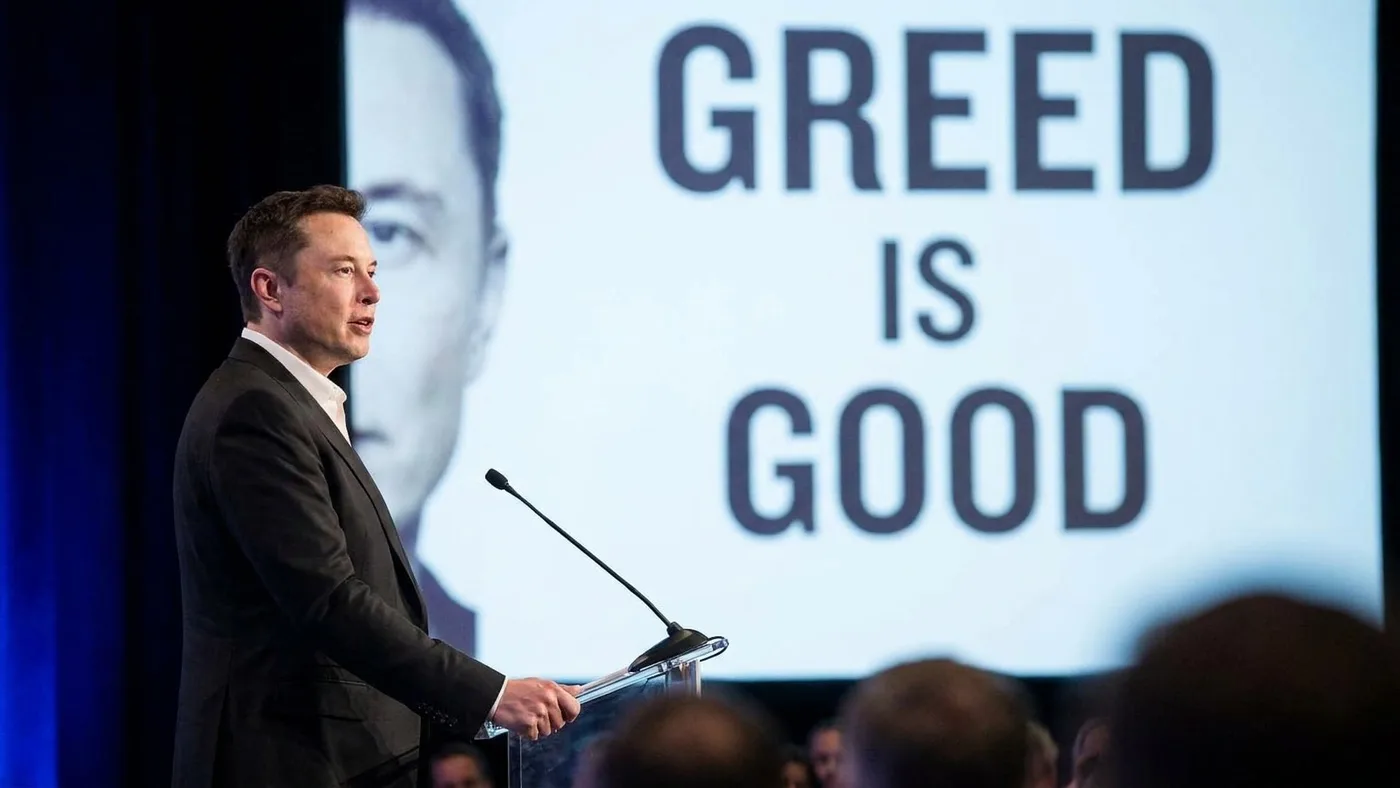
In 1987, the fictional corporate raider Gordon Gekko summed up the mantra of classic capitalism in the film Wall Street in three iconic words: “Greed is good.” For Gekko, greed was something ruthlessly rational and countable. It was built on ice-cold maths, on cash flows, undervalued physical assets and the hard facts of a balance sheet.
Now fast forward to 2026. A classic Gordon Gekko would probably fail miserably in today's hypnocracy. Because in mental capitalism, the mantra has evolved into a far more cynical mashup: “Attention is good for greed.”
Financial greed is still the goal for the architects of the platform economy, but our attention has become their ultimate lever. Anyone who wants to pile up billions in one go today has long stopped appealing to the cold calculator inside us. The new currency goes after our most emotional weak spots: the fear of missing out on the future (FOMO) and the deep longing to belong. Gordon Gekko bought undervalued companies to strip them for parts. Elon Musk sells visions to convert our attention into cash.
With this paradigm shift in mind, let's take a sober look at the prospectus, that literary genre which in the attention economy goes as thoroughly unread as software terms and conditions:
- Annual revenue: around $18.7 billion (a respectable +33% growth)
- Net loss 2025: around $4.9 billion
- Net loss most recent quarter: around $4.3 billion (a historic slump in earnings, driven mainly by breakneck AI investment)
- Accumulated deficit: more than $40 billion
Set against this is a fundamental valuation of around $1.8 trillion at listing, which approached the $2 trillion mark by the close of the first trading day. That's roughly a hundred times revenue, for a company that is losing serious money and warns in its own prospectus that profitability is not in sight. For comparison: even in the wildest phase of the dotcom bubble, multiples like that were considered exotically dangerous. Gekko would probably have shorted this stock, and lost billions, because he would have underestimated the power of the trance.
This is where something becomes quantifiable that until now was only sociological theory. Let's generously assume that an excellent, fast-growing but loss-making company justifies 15 to 20 times its revenue, a multiple that even AI hype stocks like Palantir or SpaceX's smaller space-industry counterpart Rocket Lab would consider ambitious. Then SpaceX would come in at maybe $300 to 400 billion.
The gap to the $1.8 trillion at listing? That's the market price of the narrative. Let's call it the Attention Premium: around $1.4 trillion that wasn't paid for rockets, but for a story.
4. The backstory: milestones on the road to the attention offering
This IPO didn't fall out of the sky. It's the provisional peak of a development whose milestones are easy to trace:
2018 – “Funding secured”: Musk tweets that he's considering taking Tesla private at $420. The stock explodes, the SEC sues, and it ends with a fine and a requirement to have market-moving tweets vetted. The real lesson, though, was this: A single post can move billions. Measured against that insight, the fine was a tip.
2020/21 – Dogecoin: Musk proves that his feed can even price assets with no business model whatsoever. A joke currency is at times worth more than $80 billion because one man posts dog memes. The blueprint: valuation follows attention, not substance.
2024 – the DJT stock: Donald Trump's media company shows that a business with practically no revenue can be worth billions if it trades as a share in a person, a movement, a faith. Buying the stock was a political confession, and the share price a mood barometer for the congregation.
Early 2026 – the xAI takeover: A few months before the IPO, SpaceX swallows Musk's AI company. Strategically defensible, but above all a narrative turbocharger. Rockets alone don't carry $2 trillion. Rockets plus AI plus data centres in orbit: now that's a story big enough. Anyone who read the section on AI as a hypnocracy accelerator in the first essay will recognise the pattern: AI isn't just amplifying feeds here. It's amplifying fundamental valuations.
5. Religion 2.0, capitalised
In the first essay, I argued that digital platforms are increasingly taking over the social function of religion: meaning, belonging, the promise of salvation. The SpaceX IPO is the moment this Religion 2.0 passed the collection plate for the first time at trillion-dollar scale.
Try reading the prospectus not as a financial document but as scripture: “Making life multiplanetary.” That's not a cash flow forecast. That's a promise of salvation: the rescue of the species, securitised in shares at $135 apiece. Whoever subscribes isn't investing in quarterly figures. They're buying a berth on the Ark.
And the congregation showed up: retail investors who have followed Musk in their feeds for years, who watched every Starship landing live, for whom buying the stock is the logical continuation of the like. Followers were believers. Now believers are shareholders. Engagement was grace. Now it's equity.
Even the word “trillionaire” works as a sacrament. Economically it's almost meaningless (paper wealth that evaporated again within weeks), but symbolically it's enormous: wealth as proof of being chosen. Max Weber would have had a field day. The old Calvinist idea that earthly success signals divine election returns as a Nasdaq ticker.
But reality is merciless. Yesterday's plunge to $131 is the rude awakening after mass. Attention has moved on: to the next launch, the next scandal, the next post. What remains is what was there all along: an impressive but massively cash-burning space company.
The trance has a half-life. The balance sheet doesn't.
6. Conclusion: cognitive sovereignty in your portfolio
What does this IPO teach us? Not that Elon Musk is a fraud. SpaceX builds real rockets that really fly. The lesson is far subtler and therefore more important: The capital market has become the next arena of the attention society. What the first essay described as the battle for our minds (feeds that keep us in a trance, narratives that replace reality, algorithms that orchestrate outrage and enthusiasm) now works for securities too.
The SpaceX IPO has closed the loop: attention → emotion → faith → capital → more attention. $75 billion raised, a historically high valuation, a trillionaire for a day. And then: pffft... $131 and red numbers in the portfolios of all those believers who gave in to FOMO. Attention can be harvested, but it can't be stored.
And this is exactly where the cognitive sovereignty from my essay becomes tangible, and gets a real price tag in dollars and cents.
Because what does it mean to invest in a hypnocracy? It means that subscribing to a stock can feel like a like: impulsive, emotional, driven by the need to belong. It means the feed that has been serving us Starship landings and Mars visions for years was in truth a years-long roadshow we simply never recognised as one. It means the simple story (“Mars! Trillionaire! Get in now!”) effortlessly drowns out the complex truth (“fascinating, loss-making, high-risk”), because it's shorter, louder, and hits our reward centre instead of switching on our brain.
In this context, cognitive sovereignty means:
- Hitting the pause button when the feed pushes you to subscribe. No algorithm in the world rewards pausing, which is exactly why it's the most defiant intellectual act there is.
- Choosing the prospectus over the promise. 400 pages of risk disclosures are the absolute opposite of infosnacking, and that's precisely why they're the nourishing meal that the feed's bag of crisps has painstakingly trained us out of.
- Separating narrative from substance. Asking yourself honestly with every investment: How much of this is the company, and how much is the story? And who actually profits from this story being told over and over?
- Questioning your own sense of belonging. Am I buying this stock because I've understood and checked the sober numbers, or because I simply want to be part of the congregation hoping for salvation?
That uncomfortable knot in the stomach some retail investors felt yesterday looking at their red portfolio at $131 is exactly the same warning signal as the comfortable numbness after hours in front of a screen: it's the painful hint that the system has successfully manipulated us. But it also shows that we still notice. And whoever notices can start thinking for themselves again.
With this record IPO, hypnocracy has proven that it can not only shape our innermost truths but steer massive markets. The saving answer remains the same as in the first essay, except that now it also protects your savings account: give free human decision-making and your own mind priority over the curated simulation.
The trance has a half-life. A clear head doesn't.
Live long and prosper 😉🖖