Artificial intelligence is the new spam, and we don't have a filter for it yet. Every day brings fresh headlines announcing the next big breakthrough, usually wrapped in dramatic rhetoric that swings between promises of salvation and visions of doom. Yet much of what gets celebrated as “revolutionary” today isn't really new. The foundations of modern AI go back decades. The only new things are the speed at which these technologies spread and the sheer media force with which they're staged.
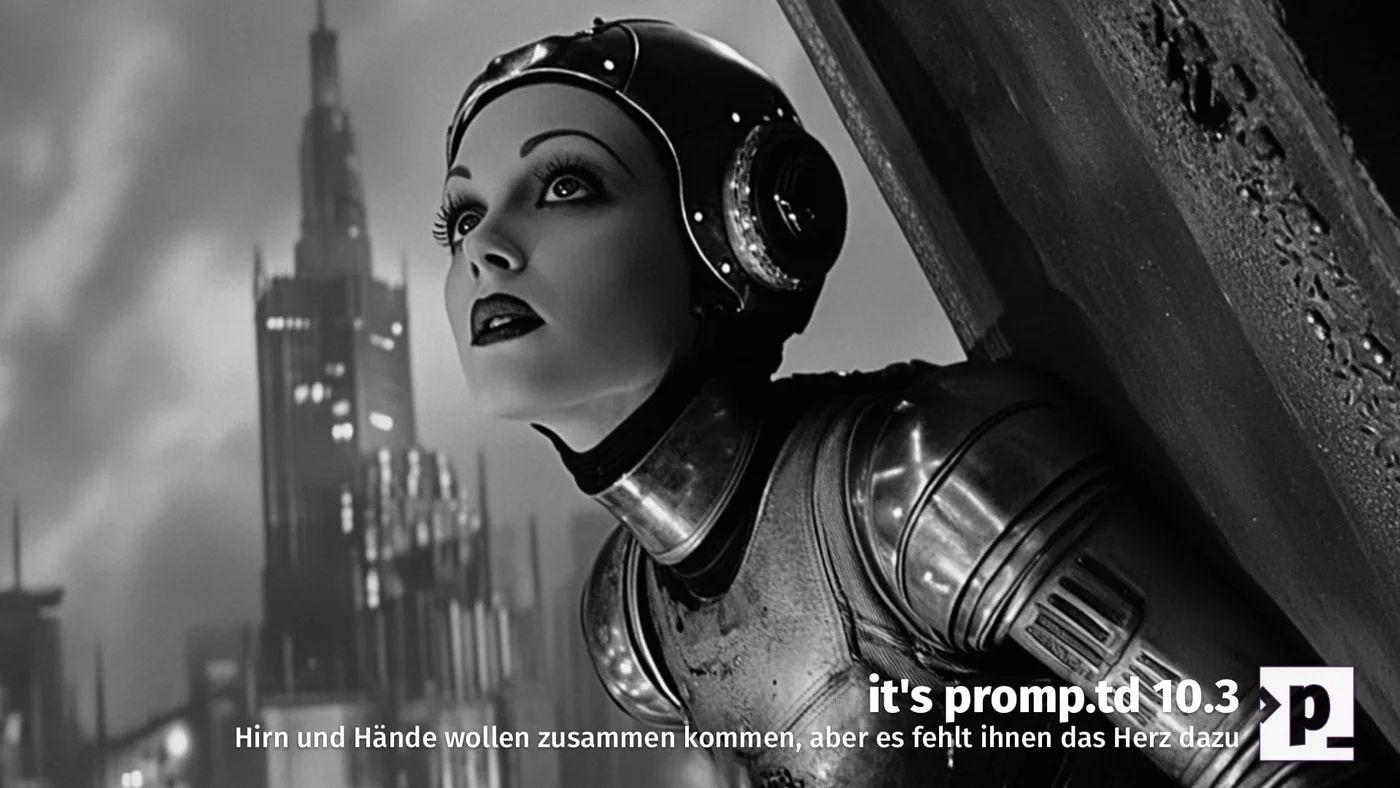
A quick look back through cultural history shows that our fascination with intelligent machines is no invention of the digital age. As early as 1927, Fritz Lang sketched a striking vision of a highly technologised future in Metropolis, complete with a human-like machine standing for power, control and illusion. The film isn't just a cinematic masterpiece (the AI-restored and colourised version is absolutely stunning!). It's also a mirror of the eternal ambivalence of technological progress: between hope and warning, between utopia and dystopia.
Today, almost a century later, we're still standing at the same spot. And instead of using the food for thought Fritz Lang already served us, we lose sight of what matters, buried under buzzwords, investor hype and clickbait. That's why it's worth pausing and taking a closer look: Which developments actually matter? Where is real social, economic or creative value being created? And where are old dreams and old promises simply being repackaged?
To do that, we have to keep walking old paths and put familiar first principles back at the centre.
Knowledge is power – Peter Drucker said so (and we can take his word for it)
Back in 1959, long before laptops, the internet or artificial intelligence, Peter Drucker, the founding father of all management consultants, spotted a profound shift in the world of work. With remarkable foresight, he put a new social figure centre stage: the Knowledge Worker. For Drucker, it was clear: the future of work would no longer be shaped by muscle power or mechanical routine, but by the ability to put knowledge to productive use, to see connections and to make decisions on one's own responsibility.
Today, more than six decades later, the concept is more relevant than ever, and at the same time strangely neglected. Because amid all the hype about AI, automation and data-driven decision-making, the role of humans as thinking, shaping beings is once again in danger of getting run over. Machines write texts, analyse data and take on tasks that were once textbook examples of human intelligence. But what often gets overlooked is this: data alone isn't insight, and information doesn't replace judgement.
It's not just about consuming information or operating tools. It's about one thing and one thing only: acquiring, improving and spreading knowledge. It's about thinking critically, asking questions, taking responsibility, and understanding technology as a tool, not as a substitute.
And precisely at a time when automation is becoming the norm, the ability to interpret meaningfully, to reflect ethically and to decide consciously is gaining weight again.
So if AI is tomorrow's workbench, then it's the knowledge workers, or in fashionable corporate speak "Knowledge Workers", who decide what gets built on it. And why.
WTF is a "Knowledge Worker"?
The term “knowledge worker” sounds a bit odd at first. But in a digital environment increasingly built on knowledge, creativity and connectedness, this role is crucial. Whereas traditional work relied on clear processes, predictable tasks and unambiguous results (in other words, things that are easy to automate), the knowledge worker's job is more complex and more dynamic.
A knowledge worker doesn't produce things. A knowledge worker produces decisions.
They analyse, structure, connect and interpret information. They create understanding where before there was only data. They solve problems, develop strategies, shape innovation. And they often do so self-organised, across hierarchies and across disciplines.
What does it take to be effective in this role?
- Critical thinking: Knowledge work starts with the ability to ask questions, not just to give answers. Anyone unwilling to challenge assumptions misses chances for improvement and innovation. Criticism here isn't resistance; it's an expression of responsibility.
- Self-organisation and personal responsibility: Knowledge work is hard to squeeze into hours and tasks. It needs time to think, room to prioritise and the courage to decide, even under uncertainty. Anyone who waits passively here gets replaced, not supported.
- Communication skills: Knowledge has to be shared to have an impact. The best ideas are worth little if they aren't communicated clearly, convincingly and at the right moment. Knowledge workers are bridge builders between teams, disciplines and perspectives.
- Ability to learn: The half-life of relevance for much of our information is shrinking. Anyone who wants to stay up to date today has to keep updating their knowledge, not only professionally but also culturally and technologically. Agility in your head matters more than a rigid CV.
- Ethical awareness: At a time when we expect machines to make decisions, ethical awareness becomes a key competence. What is right, what is defensible, what makes sense? The answer to these questions doesn't lie in the code. It lies with people.
The skills for the AI society are analogue, not digital
If we go back to newsletter 10.2, we can see that these traits of the Knowledge Worker, which Peter Drucker described more than 60 years ago, correlate very closely with the foundations of digital competence. And that these "skills" are very human, and therefore analogue, abilities.
And, what a coincidence, this is what the "core skills" expected of employees in 2030 look like (according to the WEC*)
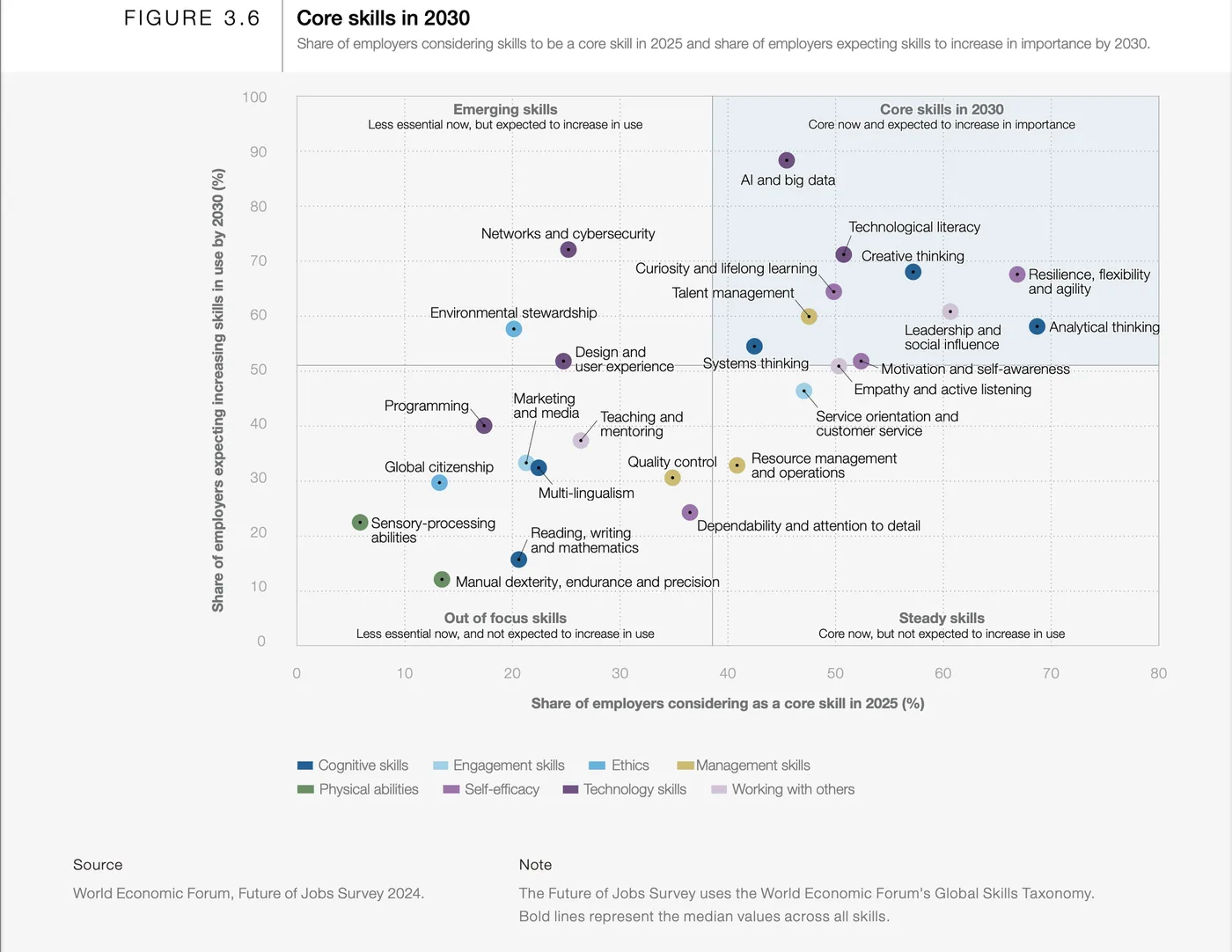
I'll leave you to mull over the top-right and bottom-left quadrants for a while and to think about what they say about our ability as a society to deal with this AI spam. Hints are very welcome 😉
Live long and prosper 😉🖖
* BTW: this chart is a perfect example of the consultant-waffle spam I'm talking about: lots of data, little knowledge ...