
The starting point: the automation paradox
We are in a phase of digital transformation in which many knowledge workers, whether programmers, consultants, lawyers or strategists, feel a quiet (and sometimes not so quiet) existential dread. The common assumption goes like this: if an AI can produce complex analyses or write code in seconds, humans become superfluous.
But anyone who tries to use AI as a pure “autopilot” walks straight into the trap of mental abdication. If you simply delegate tasks blindly, you don't just unlearn your own skills. You also never develop a feel for the AI. So the real problem isn't being replaced by machines. It's the creeping loss of our own expertise (deskilling).
The Schumpeter moment: creative destruction at your desk
To make sense of this upheaval, it helps to look at the economist Joseph Schumpeter and his concept of “creative destruction”. Every radical innovation has to destroy old structures and business models to make room for new, more valuable ones. That exact wrecking ball is swinging through our open-plan offices right now: AI is rapidly destroying the economic value of isolated cognitive grunt work.
In Schumpeter's world, this destruction comes from competitors, not from self-optimisation. Which leads to the sharper point: I can wait for the market to carry out the destruction on me, or I can carry it out pre-emptively myself, at my own desk. This destruction hurts. But Schumpeter's concept also teaches us that something new always rises from the rubble of the old paradigm.
Centaurisation: a look at the chessboard, and beyond it
When Garry Kasparov lost to IBM's Deep Blue in 1997, he didn't declare chess dead. Instead he invented “Advanced Chess”, in which humans competed together with machines. The startling result of the freestyle tournaments in the mid-2000s: a mediocre human player plus machine plus an excellent process beat not only the strongest supercomputer but also grandmasters without a comparable process. The centaur was born: the human brings strategy, intuition and the ethical frame (the upper body), the machine delivers computing power and tactics (the horse's body).
An honest analysis has to include how this story ends, though: in chess, the centaur is now extinct. Modern engines are so superior that human intervention today statistically worsens the result. Does that mean the centaur model has a sell-by date?
No, and the reason matters: chess is a closed system. Perfect information, fixed rules, an unambiguous win function. Exactly the conditions under which machines can push humans out entirely. Knowledge work is the opposite: an open system. What “winning” means is negotiable, depending on context, stakeholders, ethics and goals that keep shifting while the work is under way. An engine can find the best answer to a given question. But which question should be asked in the first place, whom the answer serves and what collateral damage is acceptable: that isn't a calculation, it's an act of framing.
So the lesson from chess isn't “the centaur always wins”. More precisely: the centaur survives wherever the win function is undefined. And that is exactly where we should move our human share of the work: away from tasks that can be squeezed into closed systems (because there we lose), towards defining goals, contexts and guardrails.
From practice: my own creative destruction
To adopt this centaur model for my own work, I first have to allow creative destruction at my own desk. To set up genuinely productive, AI-supported processes, I have to:
- Radically rethink my own processes: I have to work out where my actual human added value lies and what is pure routine.
- Cut the dead wood: Workflows and habits that were proven but are inefficient in the AI era simply have to die.
- Learn new tools: Knowing your way around ChatGPT isn't enough. This is about entirely new tools and how to chain them together.
Sovereignty as a premise
Alongside rebuilding the processes there's a second construction site, and it's what really sets my approach apart from mere “prompt optimisation”:
- Define compliance as a premise: For me, thinking vaguely about “data protection” no longer cuts it. Sovereign AI use demands absolute compliance. I have to define clear guardrails: Am I breaching my NDAs with this prompt? Who owns the intellectual property in the output? How do I make sure no sensitive client data or trade secrets leak into public models? Without this legal framework, the most powerful tool becomes an incalculable risk.
- Strictly separate workflows (cloud vs. local): As a direct consequence of point 4, I have to set up a rulebook for which non-critical tasks may benefit from the massive computing power of the cloud and which sensitive data must stay strictly isolated.
- Upgrade the hardware: The logical consequence was pragmatic: I invested in a considerably more powerful local machine so I can run data-intensive and compliance-critical processes securely and entirely locally.
(More on this in future posts, since all of it is currently a “work in progress”.)
Scenarios of centaurisation
From these first practical experiences, three modes of human-machine collaboration emerge. The decisive difference between them: how do they treat the win function of your own work?
- The “self-automator” (passive delegation): We delegate everything to the cloud AI and thereby implicitly treat our work as a closed system, as if every task had one unambiguously “right” answer that the machine will find on its own. That's the trap: whoever defines their work this way has already moved it onto exactly the terrain where machines push humans out. The result is double deskilling: we unlearn the craft and the judgement needed to check the output. The self-automator doesn't rationalise himself away because the AI is so good. He does it because he has stopped asking the open questions.
- The cyborg (fused co-creation): Human and machine work in sync and iteratively. Boundaries blur, every paragraph and every line of code emerges in dialogue. This mode shines on tasks that are partially closed: the frame is set, but execution demands constant fine-tuning (pair programming with AI, text revision, exploratory data analysis). The risk: if you work fused all the time, you lose the distance needed for the strategic question of whether the whole thing is heading in the right direction at all.
- The centaur (curated division of labour): Here the dividing line stays sharp. The human keeps control of the what (goals, context, guardrails, evaluation), the machine takes over the how. This mode wins wherever the win function is open: strategy, prioritisation, ethical trade-offs, the decision about which problem should be solved in the first place.
The punchline: cyborg and centaur aren't competitors, they're gaits. A sovereign knowledge worker switches between them deliberately: centaur when framing, cyborg when executing, and never self-automator. It only gets dangerous when the switch happens unconsciously: if you sink into cyborg mode and never climb back into the centaur's saddle, you drift gradually into self-automation. This deliberate mode-switching is the real newskilling of our time. (The centaur/cyborg distinction goes back to Ethan Mollick. The insight that switching between modes is the actual competence is the lesson from my own work in progress.)
The lever: AI as a decision amplifier
In an earlier post I put forward this thesis: “Automating knowledge work with AI means emphasizing the quality of decision-making.” The scenarios now show why that isn't a platitude but the actual mechanism behind everything.
When executing knowledge work becomes almost free, the bottleneck shifts. The scarce resource used to be implementation: writing analyses, producing code, creating documents. Now the scarce resource is the decision about what gets implemented, within which frame and towards which goal. And wherever the bottleneck sits, value concentrates. Economically, there's nothing new here: the scarce factor sets the price. The only new thing is that the scarce factor is now called judgement.
But the thesis has an evil twin that often goes unnoticed: automation forces decision quality, whether we like it or not. Because AI is a decision amplifier. Good framing gets multiplied a thousandfold by the machine. So does bad framing. If you used to build a false assumption into an analysis, you produced one flawed document. If you build a false assumption into an automated process today, you mass-produce flawed documents: at machine speed, professionally formatted and with the appearance of thoroughness.
This is the real reason the self-automator fails. Not because he decides too little, but because he decides unconsciously. Every unchecked prompt, every blindly accepted output is a decision he makes without recognising it as one. He isn't delegating the work. He is quietly delegating his judgement. The centaur, by contrast, understands: the machine doesn't take decisions off my hands. It makes every one of my decisions more consequential.
Which also makes clear why the ability to verify isn't an academic virtue but an operating requirement: in a system that amplifies my judgements, the quality of those judgements is the only adjusting screw I still hold in my own hand.
The evolution: the rise of the “Creative Generalist”
That brings us to the centaur's true superpower. If you outsource repetitive specialist work to the AI, you're no longer confined to your old specialist silo. The centaur becomes the Creative Generalist.
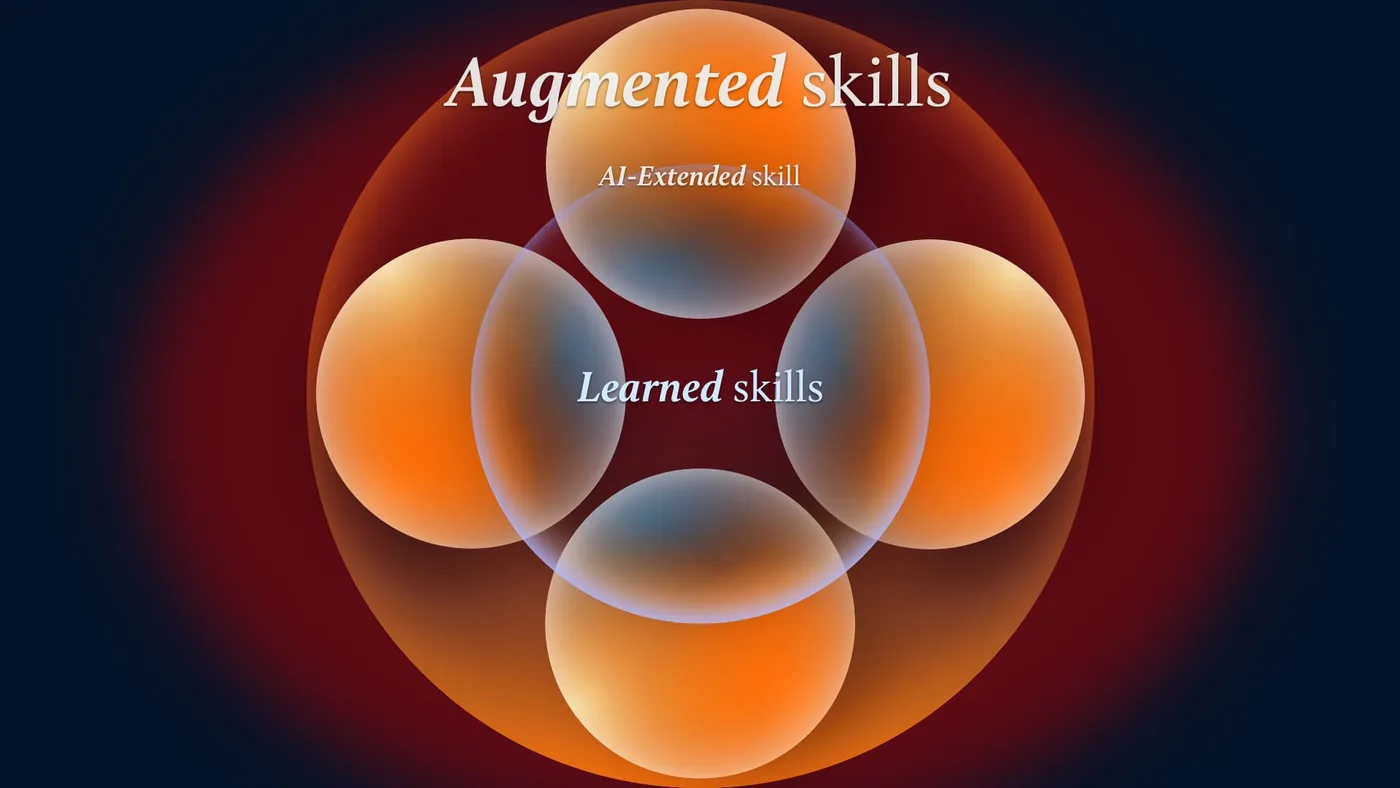
Because the machine makes access to unfamiliar expertise dramatically easier, a strategy expert can suddenly weave programming concepts into her thinking, or a sociologist can run in-depth economic data analyses with the help of AI. The barrier to concepts from other industries drops, and that opens up new intellectual horizons. Human creative contribution no longer lies only in hoarding specialist knowledge, but in masterfully connecting interdisciplinary dots as a “Creative Generalist” and developing them into novel solutions.
But here lurks an objection I have to put to myself: isn't the Creative Generalist just a self-automator with a better self-image? If I warn against deskilling through blind delegation, why should borrowing someone else's expertise of all things be harmless? A strategist who adopts AI-generated programming concepts without being able to judge a single line of code isn't a generalist. He's a risk with self-confidence.
The resolution lies in a distinction that becomes central in the AI era: generating competence vs. verifying competence. I don't need to be able to programme myself to weave programming concepts into my strategy. But I do need to understand enough to spot when the AI is handing me plausible nonsense. This verifying competence doesn't fall from the sky. It grows through symbiotic learning: debating with the models, questioning claims, using the AI's mistakes as learning opportunities. The generalist builds a minimum of depth in every unfamiliar field. Not to do the work, but to have a say in the decisions.
So the honest formula is this: the Creative Generalist isn't a state you reach by having AI access, but a discipline you have to earn. Skip the verifying competence and you're not a centaur with broadened horizons. You're a self-automator rationalising yourself away in several fields at once.
Ways forward: how we stay in the saddle
How do we institutionalise this mindset?
- Rethink the division of labour: AIs take over the “brute force” part of knowledge. The human, as creative generalist, focuses on framing, context and interdisciplinary synthesis: the open parts of the system.
- Symbiotic learning: A centaur argues with the models. The AI's mistakes are opportunities to sharpen your own mental model of new fields and of your local setup, and to build the verifying competence without which nothing else works.
- An “override” culture: The most important skill is deliberate mode-switching: knowing when you have to be a centaur (override, frame) and when you can afford to be a cyborg (fuse, iterate). Only those who can verify can override.
Conclusion, visor up
Creative destruction in knowledge work is in full swing. We are not facing a dystopian future of human versus AI. The real competitive advantage won't lie in mere access to cloud computing power, but in our ability to develop into Creative Generalists, to switch confidently between gaits, and to guarantee the compliance and security of our data.
But intellectual honesty demands naming three counter-scenarios:
- The chess scenario: What if agentic AI takes over the curating as well, and the centaur turns out to have been just a transitional phase, as in chess? Possible. My bet: in open systems without a defined win function, framing stays human. But that's a bet I have to review regularly, not treat as a law of nature.
- The inflation scenario: If anyone can become a Creative Generalist, the market value of the role drops. The advantage then lies not in the label but in excellence of execution: in the process, in verifying competence, in discipline. That's precisely why the prompt is interchangeable and the process isn't.
- The privilege scenario: My solution (local hardware, my own compliance frameworks, autonomy over my own workflows) assumes resources and freedom of choice that many employed knowledge workers simply don't have. Centaurisation is (still) also a question of position. Those who have that position carry a responsibility to pass on what they learn; those who don't should demand it within their organisation.
So the real strategic question isn't whether AI will replace us. It's which parts of our work we have downgraded to closed systems ourselves without noticing. If you cut the dead wood, radically reinvent your processes and cultivate your own verifying competence, you end up not only on safer ground but also seeing further beyond your own backyard, so you can do what a machine can't. Not yet. And keeping that “yet” firmly in view is the centaur's core task.