TL;DR?
Here's the Prompcast
The current debate about artificial intelligence is one exhausting cacophony. Every day we get hit with announcements of new, even more powerful models, jaw-dropping demos and the bold visions of tech prophets. The media spotlight of the “Attention Economy” is glaring, and it's fixed on a handful of very loud players who dominate the public narrative.
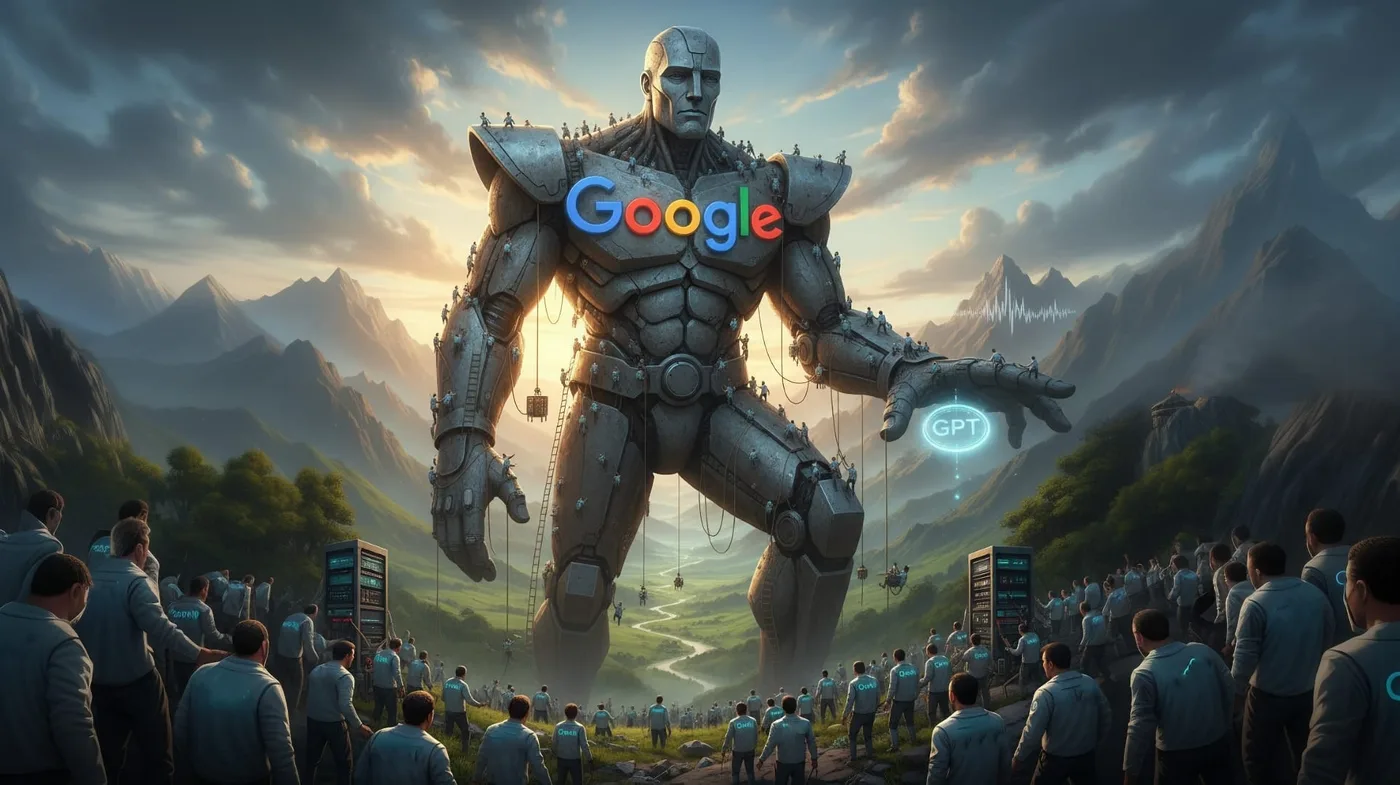
But what if the loudest one in the room isn't necessarily the one in the lead? What if the decisive strategic moves are being made in relative silence, far from the noise of the hype? That's the idea I want to take apart today: the real, long-term leader in the AI landscape may well be the one we talk about comparatively little in this context. Alphabet/Google. Its dominance rests on deep structural advantages that competitors will struggle to overcome, and short-term sprints have little to do with it.
The quiet giant
Let's cut through the background noise and look at the fundamental strengths that put Alphabet in a unique position.
A money machine that's almost hard to believe
Alphabet just reported a profit of 35 billion US dollars for the last quarter. At a time when building and training frontier AI models swallows billions and many competitors are hoping for the next funding round, Alphabet sits on a seemingly bottomless source of cash, fed by its own highly profitable core business.
For an overview, here's how the quarterly profits of the “Big Six” compare
- Google (a.k.a. Alphabet): $35B (!)
- Microsoft: $27.7B
- Apple: $27.5B
- Nvidia: $26.4B
- Amazon: $21.5B
- Meta: $2.7B (without a one-off tax charge of almost $16B, though, the profit would have been $18.6B)
This overwhelming financial strength is more than just an advantage. It's the first strategic weapon. It lets the company keep pace in any technology race and invest in every conceivable niche where it seems necessary. While others have to worry about profitability, Alphabet can invest with the calm of a reigning champion.
The real inventor of the AI revolution
It's one of the great ironies of recent tech history: Google “invented” the core technology behind today's large language models (LLMs) back in 2017. The famous “Transformer” architecture, the foundation almost every current AI model is built on, came out of the labs of Google Research.
The fact that another company, OpenAI, stole the show with this technology and captured public perception doesn't change the fact that Alphabet has invaluably long and deep experience in this field. They weren't just in the game; they defined the playing field in the first place.
The unbeatable ecosystem: the real moats
Perhaps the most decisive advantage, however, isn't the technology on its own. It's how that technology is woven into an established ecosystem. An AI model is only as good as its ability to reach the user. And here Alphabet is practically unassailable. Let's look at the facts, the company's real moats:
- Browsers: top dog with Chrome
- Smartphones: top dog with Android
- Video content: top dog with YouTube
- Search engines: top dog with Google
- Online advertising: one of the leading top dogs alongside Meta
Alphabet controls many of the primary interfaces to the digital lives of billions of people. It owns the operating systems, the browsers, the video platforms and the search boxes into which AI can and will be seamlessly integrated. On top of that comes a solid foothold in productivity with Google Workspace. While others first have to laboriously build channels to get their AI to users, Alphabet already owns the highways.
Quo Vadis, (open)AI?Billions in capital, but no clear ROI: the AI industry is searching for a business that actually holds up. OpenAI is experimenting with social apps, business tools and hardware to reach sustainable profitability. A test run for the future of the AI economy?DocIsInDaHouse
The complete tech stack from a single source
Alphabet's dominance reaches beyond software and user base, all the way down into the fundamental layers of the technology. The company controls the entire value chain.
It doesn't just have its own globally distributed data centres (Google Cloud); it also develops excellent in-house models for every modality: for text (Gemini), for images (Imagen) and for video (Veo). This vertical integration gives it a level of efficiency and control that pure software vendors can't reach. This closed loop doesn't only cut costs and thereby reinforce its enormous profitability, it also enables seamless integration into the ecosystem, a strategic advantage that keeps reinforcing itself.
Who can really challenge the quiet giant?
Put these points together and a clear picture emerges. Alphabet's dominance in the AI age doesn't rest on a single superior model. It rests on a foundation of four unshakeable pillars: extreme profitability, groundbreaking pioneering work, an unparalleled distribution ecosystem and control over the entire tech stack. Any competitor may be strong in one of these areas, but none combines all four with this kind of force.
Others still have to gain a foothold where Alphabet has been the undisputed market leader for years. This structural superiority leads me to a clear conclusion, one I've held for quite a while:
For me, Alphabet/Google has long been the quiet AI leader that all the others, the much louder ones, first have to challenge.
So the crucial question isn't whether Google can catch up in the AI race. The question is whether any challenger can ever get across the moats Alphabet has dug deep into our digital everyday lives and become a genuine threat.
Anyone who wants their own AI strategy to rest on something more sustainable should put Alphabet at the top of the list. Especially if you want to bet on a company that's successfully at home in both “Social IT” and “Business IT”.
The Great IT-Divide: Why AI-Adoption in enterprises is failingIT innovation moved from business tools to social tech, creating two distinct IT worlds: Business-IT (compliance, efficiency) and Social-IT (social interaction). Grasping this divide is crucial for enterprise adoption and explains why businesses struggle with AI uptake.DocIsInDaHouse
Too Long, Don't Read? No problem: here's the Prompcast 😉