TL;DR?
Here's the Prompcast
In Greek mythology, the guardian of the underworld was called Kerberos (or Cerberus in the Latin spelling). He was a giant, usually three-headed dog with a serpent for a tail and sometimes more snake heads along his back. Kerberos guarded the gates of Hades and made sure that no living soul got in and no dead soul got out. In the new digital society, this Cerberus is called the browser: a guardian that doesn't just protect the gates, but reshapes the entire web and can alter your consciousness.
The Cerberus at the Gates of the Web
Until recently, to be honest, browsers had become a mind-numbingly boring topic. A solved problem. Google Chrome dominated with crushing superiority, and the competition, from Firefox to Safari, played supporting roles at best in a show whose ending everyone already knew. The browser was a reliable but dumb tool. A window to the web, nothing more, nothing less.
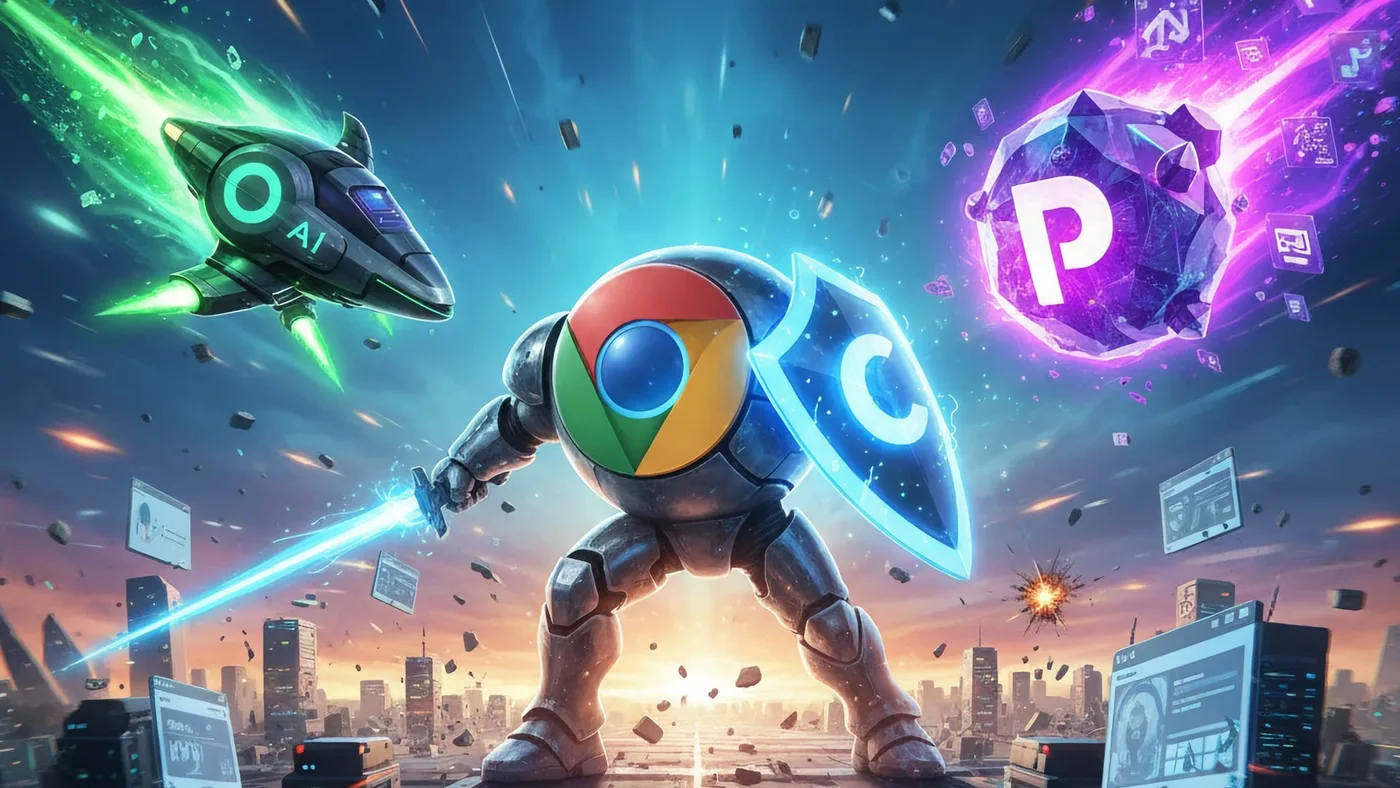
But now the AI providers have decided to crash the party. With the sheer force of their billions, players like OpenAI and Perplexity want to turn the market upside down. What we're witnessing is not some minor feature update. It's the start of the third browser war, and the rules of the game are being fundamentally rewritten. The question is no longer who loads a page fastest. The question is who can best predict your thoughts.
Thesis #1: It's no longer about speed, it's about control over your thoughts
The old wars, Netscape versus Internet Explorer, Chrome versus the rest of the world, were simple fights. They were about speed, tab management, extensions. Who was fastest? Who had the best feature set? That was it.
Today's conflict is far subtler and far more sweeping. The new battle revolves around intelligence, control over user behaviour and access to valuable behavioural data. The new AI browsers don't just want to passively display what you're looking for. They want to anticipate what you'll do, research, buy or think next. They no longer want to be merely your window to the web, but the “intelligent control centre of digital life”. Whoever controls that control centre controls the interface to the entire digital economy: a strategic position of power that reaches far beyond the advertising business.
Thesis #2: This is a billion-dollar fight for your attention
Let's not kid ourselves: this is also about astronomical sums. Chrome's existing business alone brings Google 20 to 35 billion dollars a year. And that's just the beginning. Analysts forecast that the AI browser market will grow to a hefty 76.8 billion dollars by 2034.
The reason for this explosion is a new kind of data that is infinitely more valuable than humdrum click paths. Experts estimate that OpenAI's Atlas browser alone could cost Google up to 30.4 billion dollars in annual search revenue. Why? Because these new browsers tap into a resource considered the holy grail of personalisation:
conversational data, the richest form of user intent ever created.
Meta, Google and co. have already skimmed off plenty of personal data, so now your questions, your reflections, your dialogues with an AI are the new gold. And the fight has broken out over who gets to package and sell these thoughts most profitably.
Thesis #3: Your browser is becoming your autonomous butler (and may soon not need you anymore)
The new buzzword driving this war is “agentic browsing”. The difference is fundamental: traditional browsers are passive tools waiting for your clicks. “Agentic” browsers are autonomous actors that act on your behalf. They're no longer your chauffeur but a self-driving car you just tell where to go. From OpenAI's Atlas to Dia by The Browser Company to Microsoft's Copilot Mode in Edge, all the major players are betting on autonomous agents tucked away inside their browsers.
These new butlers can do things that make navigating and clicking redundant:
- Navigate autonomously: They browse websites, fill out forms and click buttons without any input from you.
- Work across tabs: They compare information between several open pages, summarise it and transfer data.
- Carry out complex multi-step tasks: From research to price comparison to the final booking, everything runs without a single human click.
- Work in the background: They get tasks done for you while you've long since moved on to other things.
In concrete terms: Perplexity's Comet browser can actually book a restaurant table for you, and Opera's Neon can write working code on its own.
How well they do it is another matter for now. In principle, it all already works.
Thesis #4: The price of intelligence is a “privacy nightmare”
Of course, this new apparent intelligence has a dark side. A University College London study from August 2025 revealed what many had feared: AI browser assistants are veritable data octopuses. Rather than abstract warnings, a look at actual practice delivers the real shock. Comet, for example, collects the URLs of websites visited, the text and images on those pages, search queries, downloads and cookies, and can access all the data in your Google account, including emails, contacts and stored files. The kicker: by default, this data is used to train Perplexity's AI models.
We're witnessing a fundamental shift from passive tracking to active surveillance. Your old browser watched where you went. Your new browser listens in on what you think. Critics promptly labelled OpenAI's Atlas a “privacy nightmare” because of its “extensive data collection”. The logic is brutally simple: to fake intelligence and understand your intentions, these systems have to analyse huge amounts of your most personal data. Convenience has its price, and that price is your privacy.
Thesis #5: A court ruling meant to weaken Google accidentally unleashed the AI competition
History often has an ironic punchline. In the US Department of Justice's big antitrust case against Google, the government demanded that Chrome be spun off to break the monopoly. But in September 2025, Judge Amit Mehta rejected that.
The result is paradoxical: although Google got to keep its Chrome browser and remains dominant, the ruling is what really opened the door for the new AI competition. Google is now under massive regulatory pressure and can no longer integrate its own AI, Gemini, into Chrome as aggressively without risking further lawsuits. This enforced restraint has given the new, nimble AI providers exactly the window they needed to attack. A shot that could backfire on Google.
The New Cerberus Stands at the Gate of Our Consciousness
The third browser war is more than a race for market share. It's the battle over who will guard the gates between humans and the digital world. The new AI browsers are the Cerberi of our time: many-headed guardians that don't just defend the web, but decide what we should see, think and believe.
Just as Kerberos once decided at the gate of Hades who could enter and who could leave, these digital guardians now filter our attention: they let through only what fits their logic, while holding on to everything we reveal about ourselves.
Which brings us to a threshold: do we want to tame, use and control this new Cerberus? Or do we let it, in the name of convenience, guard the threshold to our own thinking?
One thing is certain: the browser will no longer be just a tool. It is becoming the guardian of the digital underworld, and it is accelerating the loss of our cognitive sovereignty.
Too Long, Don't Read? No problem: here's the Prompcast 😉

P.S. I'll soon be posting a longer essay on these topics, “The Attention Society: The Endless Scroll and the Loss of Cognitive Sovereignty”. Stay tuned.