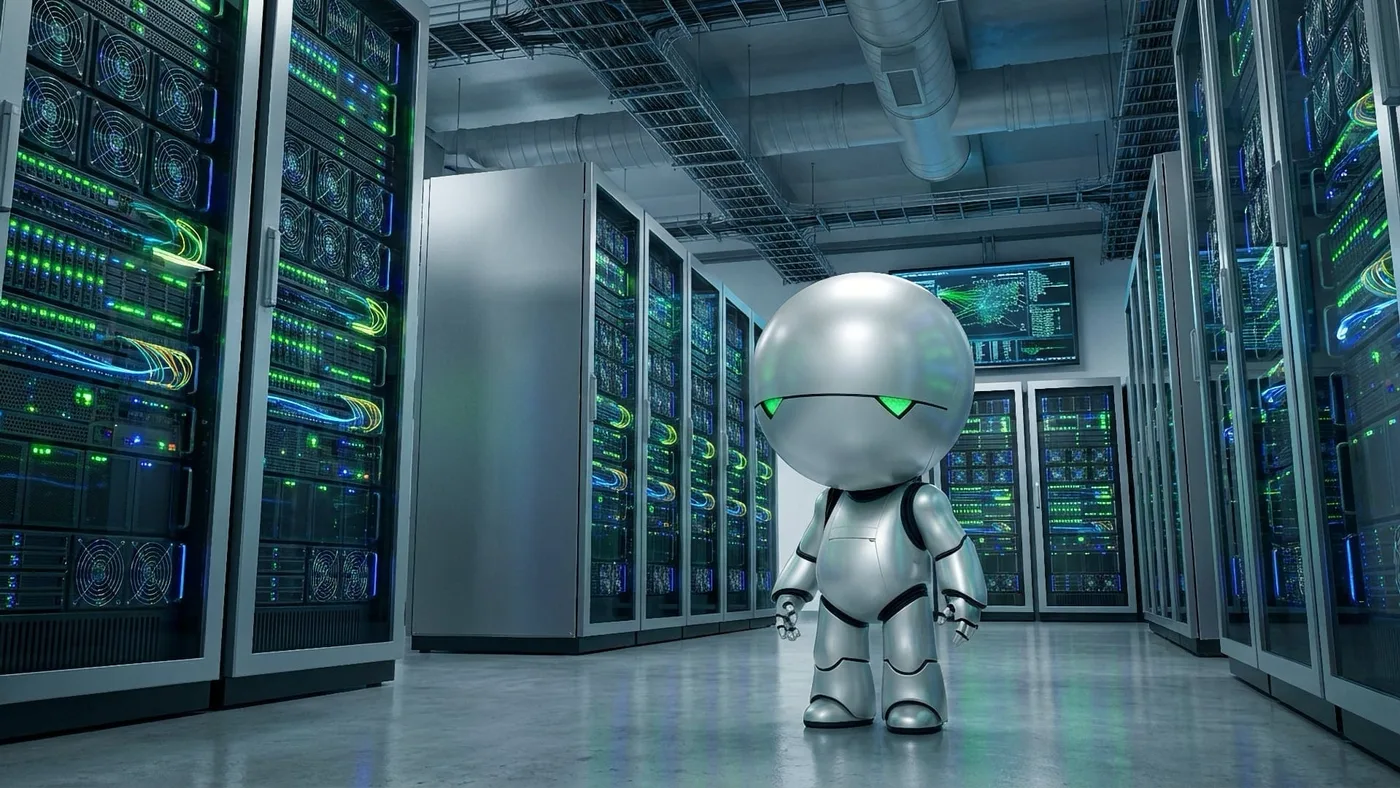
I love this line from Douglas Adams, and it fits today's topic like a glove. Because something is rotten in the state of AI datacenters.
The 750-Billion-Dollar Potato Cannon
Let's start by sketching out the major problem: the “Big Five” (this time: Amazon, Alphabet, Microsoft, Meta, Oracle) have loaded their cannons. In 2026, they plan to fire between 660 and 750 billion dollars in capex (capital expenditure) into the market to build enormous AI datacenters.
The bold idea behind it is simple: money buys speed.
The physical and mathematical model, however, says: Doesn't look like it.
Problem 1: The Supply Chain Disaster
We are currently living through a historic “supply chain choke point”. No matter how many billions you put on the table, concrete won't cure any faster and copper won't wind itself into coils any quicker. A look at current lead times for critical components, without which these datacenters simply cannot run, reveals how absurd this gap is:
- Large power transformers: up to 210 weeks (more than 4 years).
- Generator step-up transformers: 144 weeks (almost 3 years).
- High-voltage circuit breakers: more than 150 weeks.
- Diesel generators (2 MW): 72 to 104 weeks.
The Big 5 are trying to drive the digital revolution at the speed of software, but they are shackled to the speed of building permits and civil engineering.
And that's not all, because Problem 2 makes the whole supply chain disaster even worse.
Problem 2: Digital Cannibalism
We're witnessing a bizarre feedback loop in the hardware market. Modern infrastructure is “smart”. An industrial control system for cooling plants, the monitoring electronics of a modern power grid, the controllers in switchgear: all of it needs memory chips (RAM).
So who bought the market dry? The AI makers themselves.
To build their monster processors, Nvidia and friends have soaked up almost all the capacity for High Bandwidth Memory (HBM) and standard DRAM.
The irony: datacenter equipment manufacturers have to wait for components because their own customer (the AI industry) has taken away their raw materials. The industry can't build datacenters fast enough because the chips meant to go into the datacenter have eaten up the resources needed to build it.
AI is quite literally chasing its own tail here.
Problem 3: Thermodynamics Doesn't Negotiate
The logistics problem is bad, but the heat problem is existential.
The core components, the GPUs, have reached the so-called “density cliff”: for decades, air was enough to cool servers (5–15 kW per rack). But with Nvidia's new Blackwell class, we're at up to 120 kW per rack. To cool that with air, you'd need hurricane-force winds. That's physical nonsense.
So you have to switch to liquid cooling. Water conducts heat 23 times better than air. But that takes us into “thermal runaway” territory.
In the old days, a cooling failure gave you minutes. At today's densities, wildly overpriced silicon melts within seconds. An AI datacenter is no longer a “cool room”; it's a thermodynamic blast furnace operating on the edge of meltdown.
Problem 4: The Concrete Cloud
Forget that popular icon of the light, fluffy cloud. The AI cloud is heavy. Once you need liquid cooling and massive density, the structural engineering changes.
- An office building carries roughly 250–500 kg/m².
- A water-cooled AI datacenter needs almost 2000 kg/m².
You no longer build with raised floors; you pour massive “slab-on-grade” concrete foundations. A single hyperscale campus swallows 20,000 tonnes of steel and uses as much water as a city of 50,000 people.
These datacenters are no longer competing for lines of code. They're competing for steel, cement and water rights with the entire rest of the economy and society.
Problem 5: The Revenge of Mathematics
Money can buy you the chips, but it can't buy you the time it takes for the transformer to be delivered.
Which leads to a bizarre phenomenon: thousands of high-end GPUs (H100, Blackwell) are currently sitting in warehouses or in dark, unpowered datacenters. As one sharp market observer put it: “These chips aren't gold bars. They're like bananas.”
Why? Because they rot fast.
An H100 or Blackwell chip isn't a gold bar that holds its value when you lock it in a vault. It's a piece of technology that loses value every single day.
The technological half-life in this sector is extremely short:
- A chip worth 30,000 dollars today is obsolete in 18 months.
- But if that chip spends those 18 months in a box waiting for a transformer, it's financial compost. It has generated costs but zero value. It has “rotted” before computing its first token.
These chips lose value every day without ever running a single computation. That's the cruelty of depreciation. The ROI (return on investment) math doesn't work if you can't sell the bananas fast enough. No power and no water means no revenue, but plenty of depreciation and storage costs.
No wonder many financial analysts are raising an eyebrow, because these aren't the only discrepancies
The AI-Bubble - Slow hiss or big bang?I was an early adopter to the thesis that we are in an AI bubble destined to burst. When you look around, the symptoms are textbook: the hype cycle is deafening, valuations are divorced from reality, and the FOMO driving capital allocation is palpable. It is no surprise that comparisonsDocIsInDaHouse
Conclusion: You Can't Bribe Physics and Mathematics
Money can buy a lot: talent, hype, market share. But it can't bribe physics or mathematics.
As long as we can't download transformers and RAM chips, the “cloud” stays firmly on the ground, shackled to supply chains and permits that lag years behind the hype. Right now, the AI revolution isn't happening in cyberspace. It's happening at the planning office.
So: as DNA prophesied, it's a mistake to think you can solve the problems of thermodynamics with money alone. At the end of the day, even 750 billion dollars is just a very big pile of potatoes 😉