I’ve flagged the bubble forming in the AI industry a couple of times already, and now more and more unsettling news keeps landing on my news dashboard. So I’ve decided to make this post more provocative than I originally planned, because I’m increasingly convinced that something here is rotten to the core.
TL;DR?
here’s the Prompcast
The real AI nightmare probably isn’t Skynet
Forget the stories about robots stealing our jobs or kicking off a Terminator-style apocalypse. The real danger of AI isn’t a Terminator, it’s a financial collapse that could make the 2008 subprime crisis look like a walk in the park. In the real world, AI can barely organise a back office, let alone subjugate humanity. The real threat isn’t that it destroys our society from the bottom up, but from the top down: through an economic collapse of epic proportions. Remember the moment in “The Big Short” when Mark Baum grasps the absurd reality of the market and realises, with a wave of nausea, that the entire system is built on fraud? Yes, that exact moment of terrible clarity is probably what we’re living through in the AI industry right now.
1. The bubble is four times bigger than the 2008 financial crisis
Let’s set the tech propaganda aside for a moment and focus on the one number that shows how wobbly this whole house of cards is. According to Julien Garran, an analyst at MacroStrategy Partnership, the current AI bubble isn’t just big. It’s monstrous. His analysis, based on the work of economist Knut Wicksell, came to a staggering conclusion.
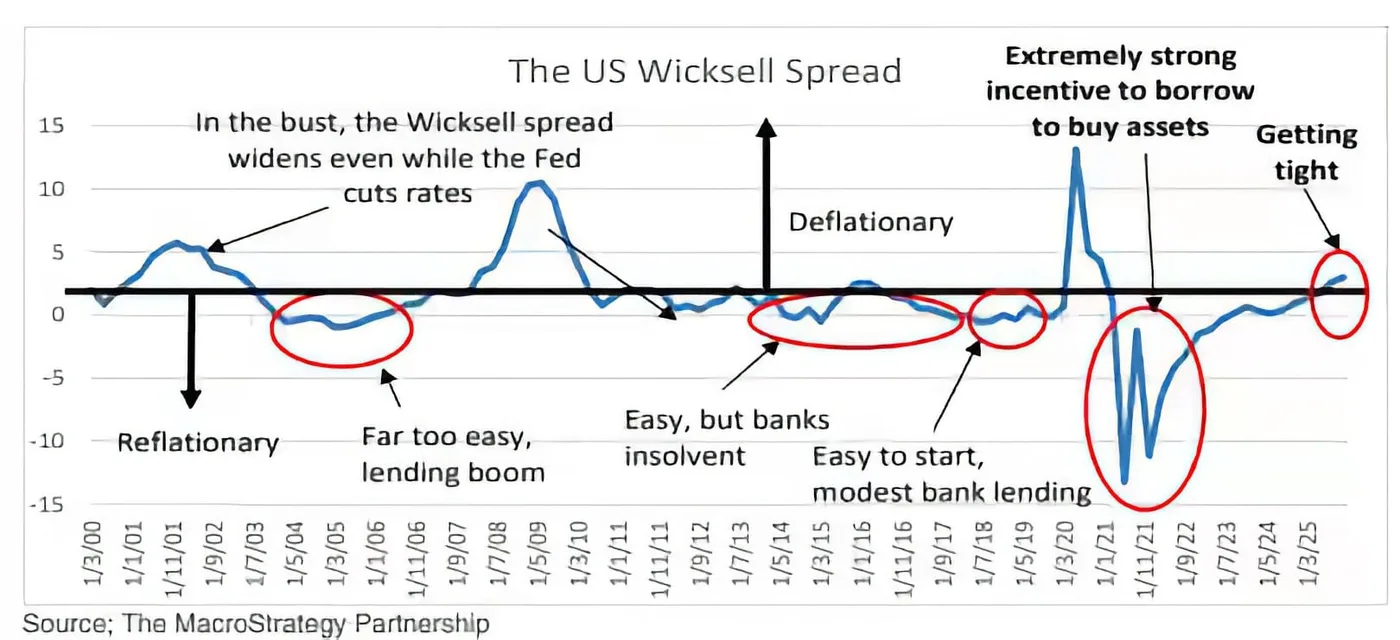
... the AI bubble is currently four times the size of the 2008 bubble at its peak!
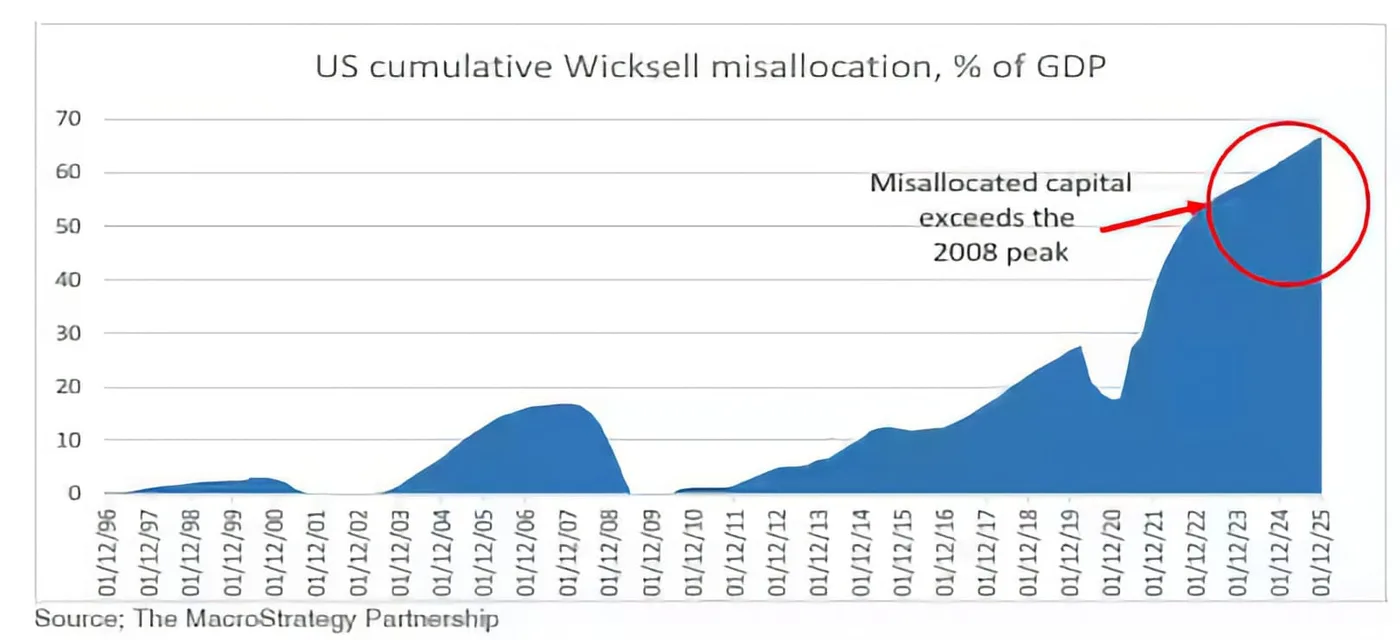
To put that in context: the 2008 housing crash cost 27 million people their jobs worldwide, led to ten million foreclosures in the US alone and caused a catastrophic rise in the suicide rate. It paralysed the global economy for years. And the bubble we’re in now is already four times as big and still growing. Let that sink in for a moment.
2. The AI industry’s “circular economy”: a market inflated by deals with each other
The financing of the AI mega-corporations increasingly rests on a so-called “circular economy”, as Bloomberg has revealed. In other words, companies like OpenAI, Nvidia, AMD and Oracle buy infrastructure, chips and cloud services from each other in the billions, while simultaneously taking on high-risk investments or stakes. OpenAI, for example, buys Nvidia chips worth 100 billion dollars, Nvidia invests money back into OpenAI, Oracle rents Nvidia chips to OpenAI, and OpenAI secures options on AMD shares.
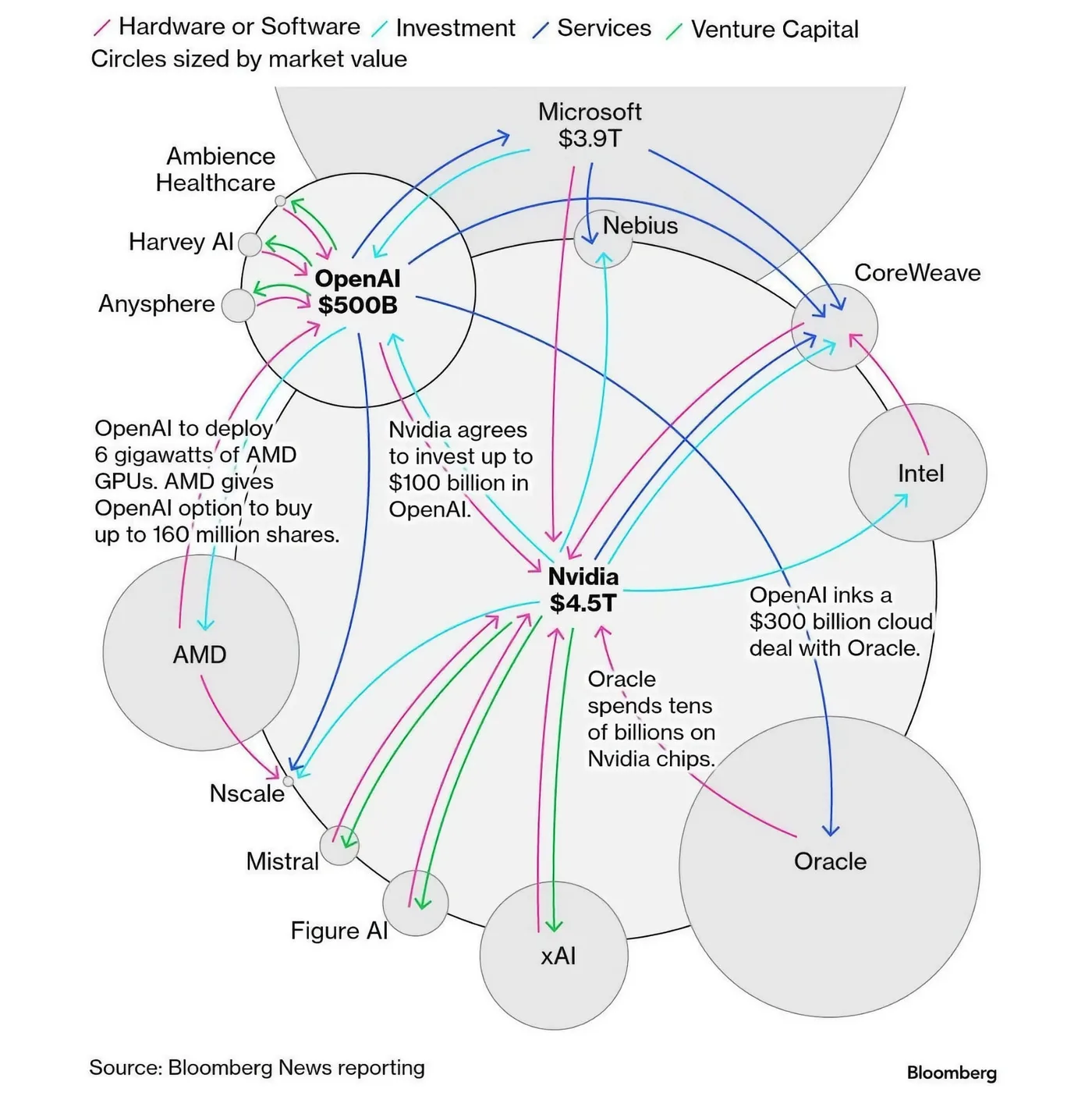
What looks at first glance like a “smart industry” is in fact a fragile web: the companies’ revenues and investments are propped up by mutual capital and service deals spinning ever faster. The industry toasts itself with seemingly astronomical growth, but real, external market demand remains doubtful. Critics speak of a “feedback loop” in which the same money and resources go round in circles and artificially inflate the balance sheets. Bloomberg warns: if one major company stumbles, a domino effect could drag the entire AI ecosystem down with it.
The parallel to the dotcom bubble is obvious: back then, Cisco financed the growth of its own customers, which led to massive write-downs and a dramatic crash. Today, much of AI’s “growth” and “investment” is worthless as long as there’s no real demand. Everything rests on the hope that the exponential curve goes on forever.
No wonder the big AI players like OpenAI are sprinting headlong forward
Quo Vadis, (open)AI?Billions in capital, but no clear ROI: the AI industry is searching for a business that actually holds up. OpenAI is experimenting with social apps, business tools and hardware to reach sustainable profitability. A test run for the future of the AI economy?DocIsInDaHouse
3. The myth of isolation: how a flood of hidden debt can contaminate everything
For a long time, people comforted themselves with the idea that the AI bubble was an isolated problem of the tech industry. Funded by equity from giants like Microsoft and Nvidia, it seemed decoupled from the rest of the economy. A soothing bedtime story for investors that, sadly, has little to do with reality. In truth, the bubble is deeply intertwined with the global economy through debt.
Because equity investment isn’t enough to cover the gigantic spending and operating losses, AI companies are quietly taking on massive debt. The secrecy is no accident but a necessity: debt comes with more scrutiny than equity, and since no part of AI is currently profitable, the industry simply can’t service debt. To hide this fundamental weakness, they use special purpose vehicles (SPVs) to disguise the loans. An example? Meta plans to raise 26 billion dollars in debt through one such SPV by the end of the year (yes, Meta!)
An analysis by Goldman Sachs shows that at least 30% of AI spending comes from “official”, i.e. reported, debt. The true figure, including the hidden loans, is probably closer to 40% or 50%. This secret mountain of debt doesn’t just serve to cover up losses; it’s the raw material for the next, even more brazen deception: selling this toxic junk to the world as a safe investment.
4. The “Big Short” moment: risky AI debt is being sold as “safe”
Here comes the eerie parallel to the 2008 financial crisis. Back then, high-risk mortgage debt was mixed with a dash of solid loans and sold as safe “investment-grade” bonds. It was a gigantic fraud that brought the entire system crashing down.
Exactly the same thing is happening again today. We’re dealing with an industry that is demonstrably unprofitable and sitting on a bubble. Loans to such an industry ought to be considered highly speculative. Instead, they’re rated as safe. Hidden in the middle of this madness is the real time bomb: the AI industry has racked up 1.2 trillion dollars in debt, and almost all of it was sold as “safe” investment-grade paper. That means more high-grade debt is now tied to AI than to US banks.
The 2008 financial crisis was triggered by securities downgrades worth 1.9 trillion dollars. At the current rate of borrowing, the AI industry will hit that catastrophic mark not in years but possibly in just six months. The clock is ticking.
5. A house of cards: the AI bubble is propping up the entire US economy
As if all this weren’t bad enough, the bubble is also artificially propping up the entire US economy. An analysis by Deutsche Bank found that AI companies’ massive spending on data centres is inflating US GDP and masking a looming recession.
Without that spending, US economic growth would be close to zero. Roughly half of the current growth of index funds like the S&P 500 can be traced back to this tech spending. Put differently: the tech industry is spending money it doesn’t have to generate growth that isn’t real, thereby propping up an economy that would already be in recession without this sleight of hand. That’s not a foundation; that’s a tightrope walk without a net.
Bottom line: buckle up, it’s going to be a bumpy ride
If all this materialises, it’s not a bubble. It’s a financial atom bomb. The crash looks inevitable, and the longer it’s delayed, the more devastating the damage will be.
The only question is when exactly the trigger comes and how far the fall will be ...
Too Long, Don’t Read? No problem: here’s the Prompcast 😉