
In July of this year, I wrote in my bubble update that the real danger of the AI bubble lies in opaque “balance-sheet feng shui” and hidden infrastructure debt. The circular financing between chipmakers, neoclouds and special purpose vehicles (SPVs) looked to me like the unhealthiest part of this party.
I was wrong. It was only one part. I underestimated the creativity of the financial jugglers.
While we were staring, transfixed, at the mountains of hardware and debt, a second mechanism has taken hold on the side of the big model developers, one that enriches this market's already fragile architecture with yet another layer of absurdity. A mechanism that takes the good old “Anything that can go wrong will go wrong” and raises it by a worrying multiplier.
Welcome to the VC money laundromat.
The Fantasy Number Factory: Hide-and-Seek with the “Run Rate”
Let's look at the astronomical revenue figures dominating the headlines around market leaders like OpenAI and Anthropic. To report these records, the industry uses a methodologically fascinating, flawed instrument: “Annualized Recurring Revenue” (ARR), or the “run rate”.
Instead of transparent, real quarterly accounts, arbitrary time windows get extrapolated. Take, for example, the usage-based API revenue from 28 good days and simply multiply it by 13. Or count gross revenue booked through cloud partners instead of reporting only the net income that actually stays in the house. That is how OpenAI's once proudly announced ARR of 70 billion dollars hastily shrank to a more realistic 50 billion dollars after critical scrutiny by the Financial Times.
Reporting run rates like these isn't financial reporting. It's a marketing exercise. And it serves a very specific purpose: keeping the system alive.
The Toxic Circle: How to Turn Losses into Growth
The labs' artificially inflated revenue rests on a closed, Ponzi-like loop in which startups function as pure extraction machines:
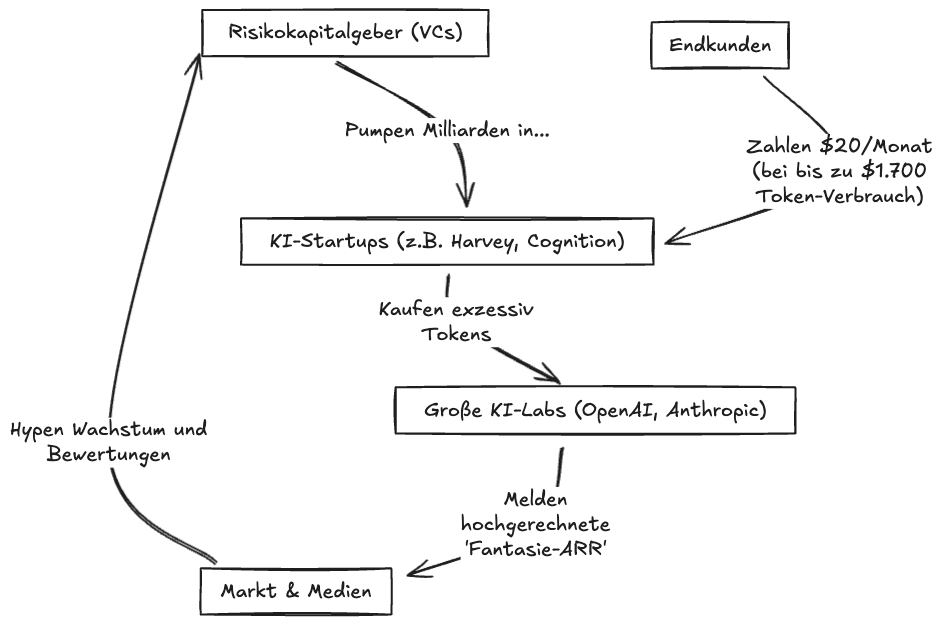
Around 80% of OpenAI's and Anthropic's revenue comes from just 1% of their customers, and that core clientele consists almost exclusively of VC-funded AI startups.
Let's look at the toxic unit economics using real startups: when an end user signs up for a flat-rate $20-a-month subscription on platforms like Cognition or Phind, they can burn through anywhere from $83 to more than $1,700 worth of the big labs' tokens in the background, unchecked. At the hyped legal AI startup Harvey, gross margin collapsed from +50% straight to -50% after a product update this spring, simply because customers started using the product more heavily.
That's not product-market fit. That's a flash in the pan fuelled by venture capital. VCs fund startups so they can dump tokens on end customers far below cost, while the investors' money is passed through to the big labs almost unfiltered to put makeup on their “growth” numbers.
The Trillion-Dollar Blind Flight: When Two Illusions Collide
Now let's merge this new laundering loop with the hardware problem from my last update. This is where Murphy starts grinning from ear to ear again.
Real GPU rental prices have been falling for a while. Anyone who looks into the SEC filings of actual long-term contracts (such as those of Krea, Canopy Wave or Sharon AI) can see that modern chips are often rented out for under $4.00 an hour. After hardware depreciation, power and operating costs, the hosting providers' margins are often wafer-thin to negative.
Even so, companies like Anthropic and OpenAI have piled up long-term compute commitments worth an incredible 1.3 trillion dollars, at least 413 billion dollars of which are strictly non-cancellable.
Do you see how far there is to fall?
The industry is stacking trillions in non-cancellable obligations on a foundation that consists to a substantial degree of a bet that VCs will keep cross-subsidising the token consumption of unprofitable startups.
No Way Out, Only Foreseeable Consequences
The AI industry is currently running two massive, interdependent manipulation machines: one that conceals hardware overcapacity through SPVs, and one that simulates a lack of real market demand away through VC money launderers.
For a long time it seemed completely open which cog in this gearbox would jam first. But current developments are showing us in real time where the cracks are forming: as recently reported, big banks like JPMorgan and MUFG are desperately trying to offload billions in freshly underwritten AI data centre debt (including Oracle's). Credit default swaps, the insurance against default on these loans, are climbing to 2009 levels. Demand for these bonds is drying up, and the banks are uncomfortably close to their own internal risk limits.
When even the architects of this debt mountain are trying to hand off the gigantic, infrastructure-bound risks to someone else before the music stops, the crisis leaves the realm of theory. The assumption that credit will keep flowing to this sector endlessly and on reasonable terms is, it seems, collapsing right now.
Murphy's Law wasn't written for systems that beg this shamelessly for a fatal failure. If the hardware credit network now stalls while venture capital for the software circle cools at the same time, the double illusion caves in on itself. Whatever can go wrong is already going wrong. We're simply watching the house of cards discover gravity, live.