
TL;DR?
Here's the promptcast
Disclaimer: the data behind this post comes from the US, where markets react to change much faster than in Europe. But it's safe to assume these trends will spread. And fairly quickly, too, because many companies are feeling a certain nervousness right now thanks to shaky global markets. AI and automation (read: AgenticAI) are powerful cost-cutting tools, even if this development is still in its infancy. And that is exactly the classic driver of business IT, and it's very hard to stop.
4 signs that AI is already reshaping the career ladder
Over the past few months, the debate about whether artificial intelligence is taking jobs away from young graduates has been a rollercoaster ride. The answers swung from “possibly” to “definitely yes” to “almost certainly not”. Until now I had settled for the first one, because as a natural scientist I like to back up theories with hard data. The prevailing view seemed to be that AI is not hurting youth employment. But a new study by economists at Stanford University, based on uniquely granular payroll data, now delivers the first real numbers and has forced me (and should force all of us) to rethink that assessment. The evidence is stronger than ever, and here are the most surprising findings.
1. The new evidence is in (and it's bad news for GenZ)
The central finding of the Stanford study is unambiguous: since ChatGPT arrived, employment among young workers (aged 22 to 25) in highly AI-exposed occupations, such as software developers or customer service representatives, has fallen by 13 percent. By contrast, employment for older workers in the same occupations remained stable or even rose, as it did in less AI-exposed occupations such as home health aides.
What makes this finding so compelling is the quality of the data. Earlier analyses often relied on government data with small sample sizes, which made precise conclusions about specific groups difficult. This new study, by contrast, uses payroll data from ADP covering millions of workers. That level of detail allows a far more precise analysis and is what makes the results so meaningful.
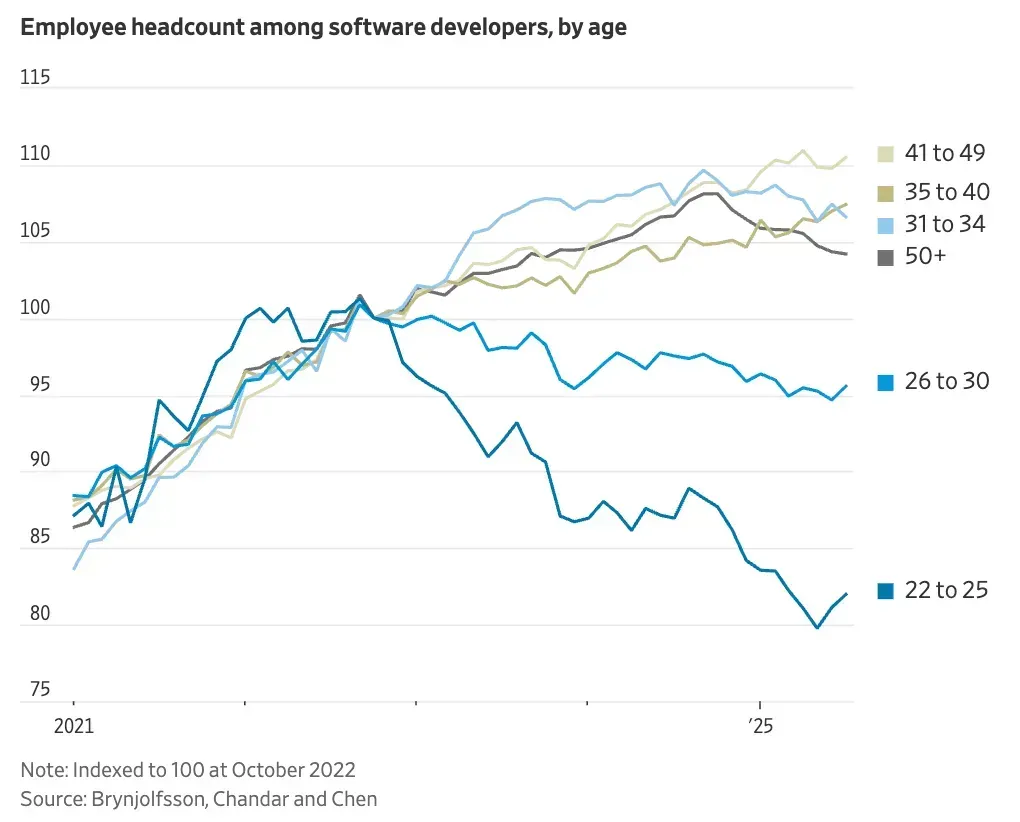
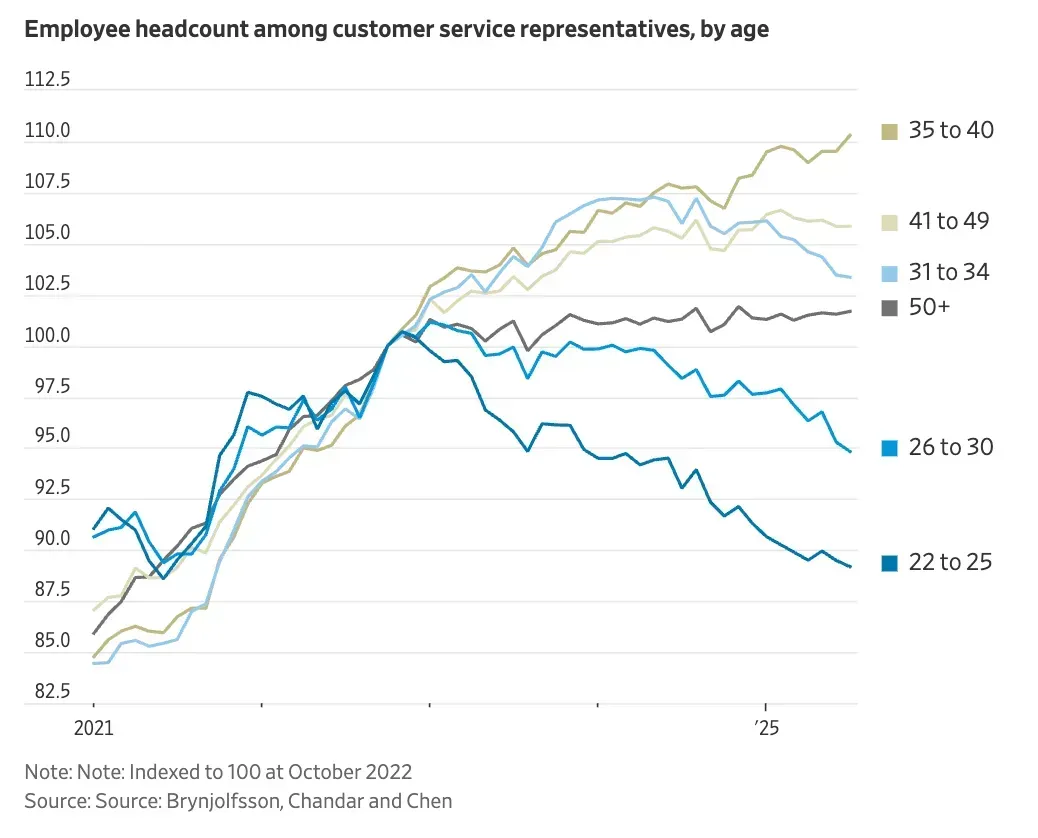
2. Forget AI versus humans: the real split is automation versus augmentation
The study draws a crucial distinction that explains why the effects are so specific. What matters is how AI is used: to automate or to augment.
- Automating tasks are work that AI can replace entirely. Examples include software development, auditing and accounting. This is where the employment decline among young people is concentrated.
- Augmenting tasks are those where AI works alongside a human and supports them, for example in more complex management or strategy roles. Here, employment for young people isn't falling. It's actually rising.
This shows how nuanced AI's impact really is. It's not a blanket “job killer” but a tool whose influence depends heavily on the type of task.
For readers of this site, this shouldn't come as much of a surprise
Episode 10.6 - Generate or delegate?DocIsInDaHouse
3. Your university degree is more vulnerable than your boss's experience
This distinction between automation and augmentation helps explain why the youngest workers are hit hardest. The reason is simple: large language models (LLMs) are trained on codified, written knowledge, meaning books, articles and the entire internet. That knowledge overlaps heavily with what students learn at university, and access to it can be automated more easily and quickly with this new technology.
Episode 10.2 - Fishing knowledge in a sea of words without drowning in it 🙂DocIsInDaHouse
On the other side stands the “unspoken knowledge” (Tacit Knowledge) of more experienced, older employees. These are the unwritten “tricks of the trade” that come from years of practice and that LLMs can't simply replicate. It's simply a fact that formal education may be easier for today's LLMs to replace than intuition and expertise gained through experience.
To make matters worse for GenZ, unsupervised use of AI tools stifles precisely the process that would let them acquire this "Tacit Knowledge" faster.
Episode 10.7 - The GenZ dilemmaDocIsInDaHouse
4. The real upheaval is happening inside companies
One of the study's findings is that these job shifts are happening even within one and the same company. It's not that AI-focused firms are laying people off while others are hiring. Instead, within a single company, jobs in highly AI-exposed departments are declining relative to jobs with lower exposure.
Specifically, the Stanford researchers found that within the same firm, the most affected jobs saw a relative employment decline of 13% compared with the least affected ones. That's the “smoking gun”, because it rules out many alternative explanations. This finding suggests the trend isn't being driven by company-wide factors like interest rates or general cuts to tech investment, but by the specific impact of the technology on particular roles.
Bottom line: we need to rebuild the career ladder
This study confirms what many already suspected: AI is fundamentally changing the dynamics of career development. Especially in classic entry-level positions, AI can handle many tasks faster and cheaper than junior employees. That shifts where value is created inside organisations: professionals with experience, strategic thinking and social skills are gaining importance, while the classic climb from junior through mid-level to senior is steadily losing relevance.
For career starters, this means specialising early and developing skills that aren't so easy to automate, such as analytical thinking, communication, creativity and ethical judgement.
This development confronts educational institutions and companies alike with a central challenge: if entry-level opportunities disappear through automation, the training of tomorrow's specialists and leaders risks eroding. Universities, vocational schools and continuing education providers therefore need to adapt their curricula and deliberately teach skills that go beyond merely reproducing knowledge.
Learning content should focus more on working with AI systems, critical thinking, interdisciplinary problem-solving and human-centred decision-making. At the same time, companies need new models that give young talent hands-on learning and development opportunities despite automation.
Because without a solid experience path from junior to senior, we'll lose the foundation of our innovation and leadership in the long run.
Too Long, Don't Read? No problem: here's the promptcast 😉

To the Stanford study
Canaries in the Coal Mine? Six Facts about the Recent Employment Effects of Artificial IntelligenceThis paper examines changes in the labor market for occupations exposed to generative artificial intelligence using high-frequency administrative data from ADP, the largest payroll software provider in the United States.digitaleconomy.stanford.edu · Stanford Digital Economy Lab
music stuff 🎧 (had to happen again) 😉