
The public debate is dominated by AI tools like ChatGPT, Udio or Midjourney, mostly tools that belong to the category of “Generative AI” (or GenAI) and are based on LLMs (Large Language Models). The term describes AI models that produce content: text, images, code, music and more. These systems respond to input, generate output and seem impressively creative while doing it. But: they don't act on their own. Without a direct instruction, a prompt, a generative model stays passive. No “trigger”, no action. In this article, “Episode 10.2 - Fishing knowledge in a sea of words without drowning in it 🙂”, I already highlighted the single most outstanding capability of LLMs: we can finally extract information, or rather knowledge, from large volumes of unstructured data.
Combine these LLMs with classic IT tools that work with structured data, and you get a new breed of IT systems, for which the marketing people have coined a fresh buzzword: “AgenticAI”. Connecting classic IT systems optimised for structured data (ERP, CRM, databases) with Large Language Models that can interpret unstructured data such as texts, emails or documents creates a whole new level of automation potential. This integration makes it possible to combine data from all kinds of sources, spot connections and trigger actions automatically. Picture an AgenticAI system that analyses an invoice, extracts the relevant data with an LLM, matches it against orders in the ERP and, if needed, automatically sends a query by email or initiates a correction.
AgenticAI = GenAI + automation
Unlike GenAI, AgenticAI systems can do more than produce content: they can pursue goals independently, plan actions and react to changes in their environment. The automation algorithms combine different capabilities (research, decision-making, execution) and sources of information, which lets them solve complex tasks proactively.
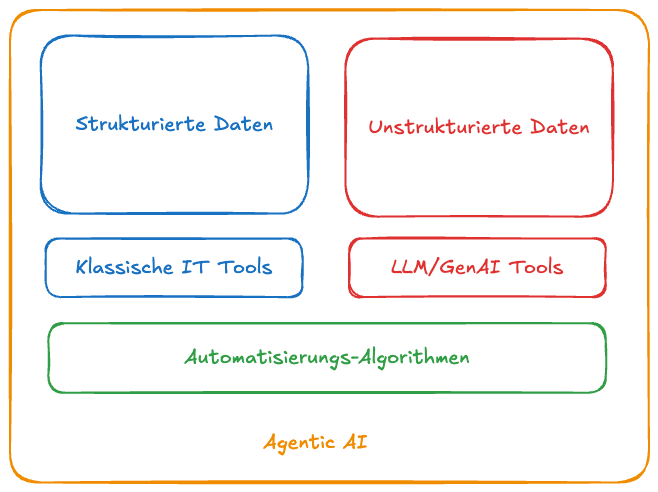
AgenticAI systems are very powerful IT systems
- Autonomous decision-making: They (or rather their algorithms) can make decisions on their own, without every step having to be defined in advance. They use LLMs to understand natural language, extract the right information from large data sets and derive actions from it.
- Multi-step task handling: They can break complex tasks down into smaller steps, plan their execution and carry them out, much like a human agent pursuing a goal and adapting flexibly as things change.
- Use of tools and systems: AgenticAI is “tool-aware”. It knows which internal and external systems it can use and drives them automatically to handle tasks like database queries, document analysis or business processes.
- Learning and adaptation: These systems collect feedback and experience to keep improving. They can adjust their strategies and models to work more effectively in dynamic, unpredictable environments. They can even adapt the algorithms autonomously.
Man-Machine? Almost: we're one step closer*
AgenticAI makes it possible to automate complex business processes that used to be too hard for classic automation, because handling unstructured data required humans. Reading contracts, processing emails, attending meetings, writing reports, and so on: these are all processes of the “knowledge worker” described by Peter Drucker, and they can now be optimised with LLMs. Considerably so. Where a human would need hours to summarise a 100-page document, an LLM does it in seconds. It can transcribe and distribute the recording of a meeting lasting several hours in a few minutes. Or classify hundreds of job applications far faster than any clerk. That is exactly where the time-saving potential lies.
AgenticAI: hugely promising, but, as always, easier said than done
The key benefits of an “AgenticAI experience” for organisations are the typical “digital transformation” benefits (so I'll spare you most of the usual marketing waffle):
- Higher efficiency and productivity: You automate routine tasks and complex workflows, cut manual effort and speed up processes. Employees can focus on value-adding, strategic work while the AI takes over repetitive, time-consuming activities.
- Better decision-making and agility: Thanks to real-time analysis of large data sets and continuous learning, Agentic AI delivers solid, data-based foundations for decisions and makes the company more responsive.
- More innovative business models: Agentic AI enables new, automated services and opens up entirely new sources of value creation.
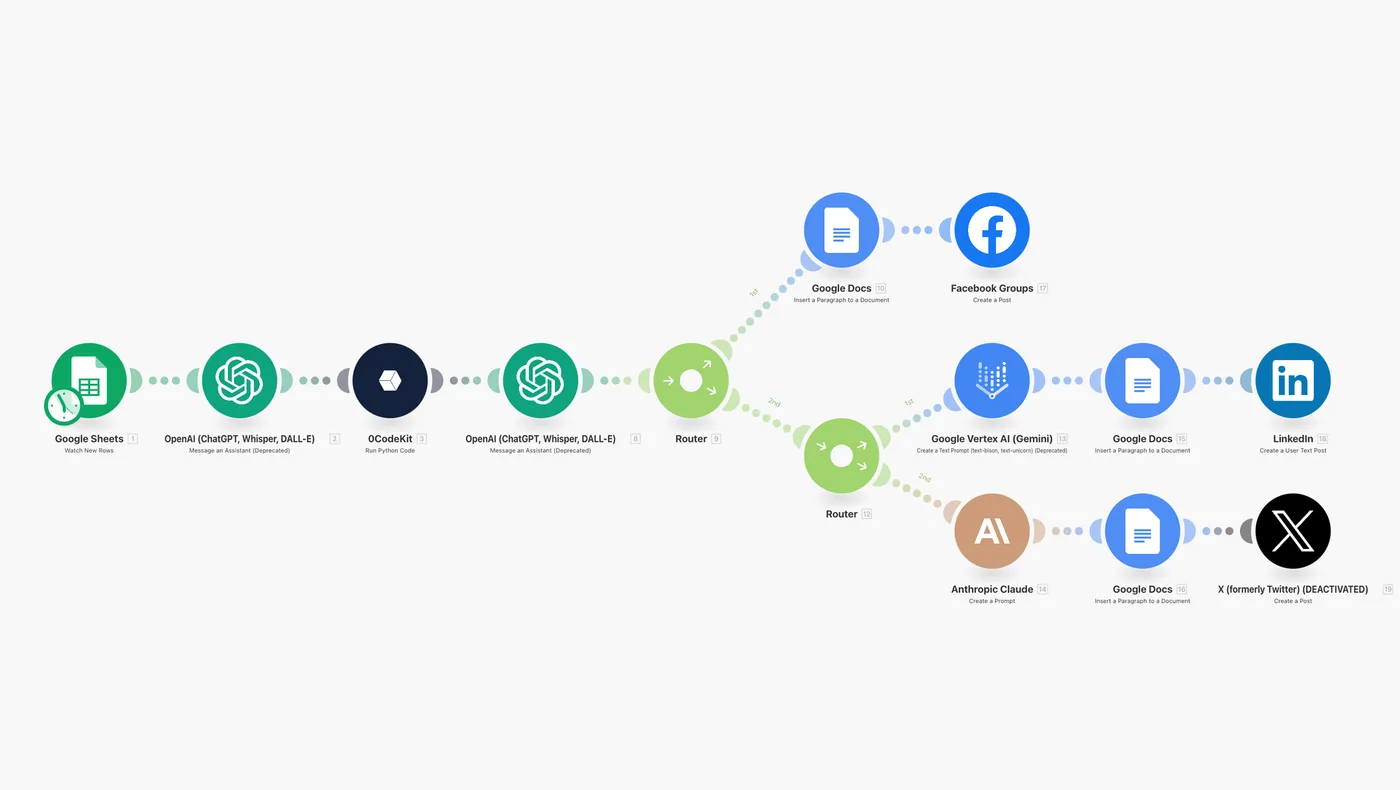
Example of an automated workflow for publishing on social media
Using AgenticAI in companies also brings a set of ethical challenges that need to be addressed carefully (here I'll spare you most of the naysayer arguments):
- Transparency and traceability: The decisions of AgenticAI systems must remain traceable and explainable. You have to make sure the logic and reasoning behind decisions are transparent and not left to a “black box”.
- Responsibility and liability: As autonomy grows, so does the question of who is responsible for bad decisions or damage: the company, the developers or the user. Clear governance structures and chains of accountability are needed to settle liability.
- Algorithmic bias and hallucinations: LLMs can inherit biases from their training data and generate false information (hallucination). Regular audits, diverse data sources and transparent models are needed to detect and correct this.
- Autonomy is good, control is better: Even with a high degree of autonomy, human oversight remains important, especially for critical decisions. Companies should define clear escalation points and control mechanisms to prevent unwanted or harmful actions.
These points make it clear that AgenticAI has to be designed responsibly not only on the technical side but also ethically, legally and socially, if it is to create lasting value and keep risks down.
A few recommendations on the road to the “AgenticAI experience”
I can only recommend evaluating the introduction of AgenticAI as quickly as possible and drawing up roadmaps for implementing it. As I said, the potential is huge and can make or break your competitive position. In my view, it starts with experimenting on a prototype infrastructure and launching your own proof-of-concept projects (POCs), while absolutely keeping the following precautions in mind:
Careful with your own data and other people's LLMs!
Before you charge ahead and automate everything in sight, be aware of one thing: if you use external LLMs, you hand over your data. The security of your own data and infrastructure is seriously at risk, and that needs to be weighed carefully. As a rule, I recommend setting up a local LLM infrastructure so you can build and test AgenticAI projects without sending data to the cloud. As for external solutions like Copilot and the like, for now I can only strongly advise against them.
LLMs need to be tailored to hallucinate less
The common LLMs that are also available as open source, and can therefore run in your own protected infrastructure, were fed with general, publicly available data and trained for general tasks. To use them for your own processes, they have to be enriched with your own knowledge and fine-tuned for your business context. That's the only way to control and improve the quality of the results.
“It's the process, stupid!”
As with any “digital transformation”, process optimisation comes first. In this case, specifically the “knowledge worker processes”. You first need to be able to describe them clearly before you can optimise them. Yet these are exactly the ones that tend not to be clearly documented, because they often run informally and unstructured, through meetings, email threads, phone calls, chats, presentations, etc. (Right, we're talking unstructured data, after all.) Analysis tools such as the OOM Scorecard help to capture and map them. If you don't know these processes reasonably well, you're poking around in the dark.
👀 Worth reading: Der Aufstieg der Nerds
⭐️ Favourite of the week: t3.chat This tool is ideal for anyone who wants to experiment and work with different LLMs and/or evaluate their pros and cons. T3 Chat is blazingly fast and lets you switch directly between several leading AI models and pit them against each other. With a clean interface and an affordable pricing structure, it has become one of my most important companions on this AI trip.
Live long and prosper 😉🖖
*Music reference 🎧 (yes, again, it just fits too well 😉)