The societal trap of a posteriori thinking
Look at the following chart and you’ll instantly recognise the classic pattern Clayton Christensen described in his theory of “disruptive innovation”. He showed, quite convincingly, why even the most successful companies of their day, from Kodak to Nokia, vanished from the market even though they seemingly did everything right.
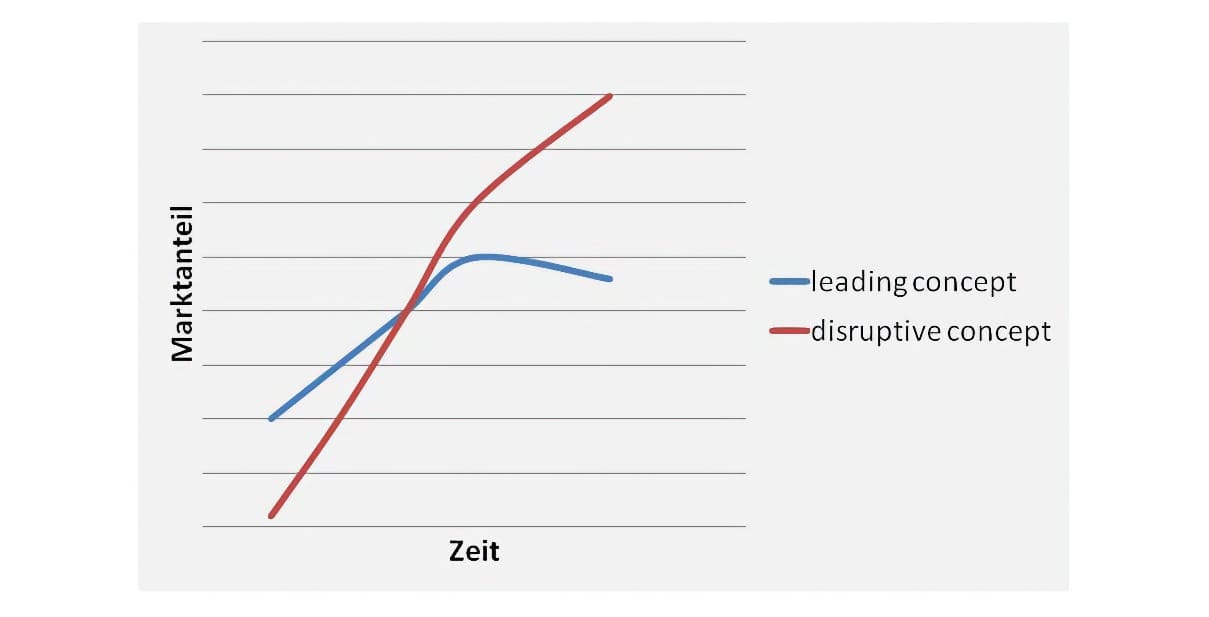
They optimised their “leading concept” (the blue line), listened to their best customers and maximised their margins. And precisely that focus blinded them to the red curve, which started out inconspicuously in a niche, only to overtake them exponentially.
To understand why we, as a society, are now increasingly being steamrolled by technology too, it’s worth going back to Immanuel Kant. He distinguished between knowledge a posteriori (knowledge from experience) and a priori (knowledge through reason, prior to experience).
Our society, our politics and our ethics councils operate almost exclusively a posteriori. We wait until problems become visible. We regulate social media only after polarisation has already destabilised democracies. We take care of data protection after the data has long since been abused. We drive into the future with our eyes firmly fixed on the rear-view mirror.
As long as innovation was linear (the blue curve), this reactive principle more or less worked. But with disruptive technologies (the red curve), the a posteriori approach is fatal. If we insist on learning from experience what AI does to our concept of truth or to human self-worth, the social damage will already be done. We have to learn to grasp these societal consequences a priori, purely by logically deriving them from what the technology makes possible, before they become a reality we can no longer control.
Phases 1 & 2: From business IT to social disruption
A look back makes the escalation clear:
In the era of business IT, the social impact was still limited. Whether a company optimised its databases had hardly any effect on a family’s dinner or on how a citizen voted. The disruption stayed inside the company walls.
That changed overnight with the iPhone and social IT (see also The Great IT Divide). Suddenly the technology moved into our pockets. We learned a posteriori what that means: the attention economy, filter bubbles, mental health problems among teenagers. We released these tools into the world first and then, years later, discovered to our shock how they had changed our social behaviour.
We didn’t want to listen to those who saw it coming a priori, and now we have to try to half-fix it a posteriori.
Phase 3: The “Genius Nation”, disruption beyond imagination
Now we’re standing at the foot of a vertical wall. What Dario Amodei, CEO of Anthropic, recently sketched out can barely be plotted on our chart anymore. We’re heading towards a reality he calls a “Genius Nation inside a Data Center”.
Imagine we’re not simply integrating a new piece of software, but a “nation” of 50 million digital workers into our servers, each one of them smarter than a Nobel laureate, working 24/7 and thinking 100 times faster than a human. That’s no longer “IT”. That’s a new species.
This phase of AI disruption brings three massive social shocks that we won’t be able to handle a posteriori:
- The “time compression” problem:
Earlier technological revolutions (the steam engine, the internet) gave society generations to adapt. The farmer became a factory worker, his son a software developer. AI compresses this process from decades into months. If entry-level jobs in law, medicine and programming become obsolete simultaneously and overnight, the mechanism of social mobility collapses before we even notice it’s missing. - Economic decoupling (the trillionaire dilemma):
Amodei forecasts possible GDP growth of 10–20 % per year. A posteriori, that sounds fantastic. But a priori we have to ask: where does that wealth end up? If AI does the work, capital accumulates on a scale that makes the Gilded Age tycoons look like small-timers. We’re steering towards a world in which individual tech companies are more powerful than G7 states. Democratic oversight becomes an illusion when economic power is concentrated this extremely. - The existential void:
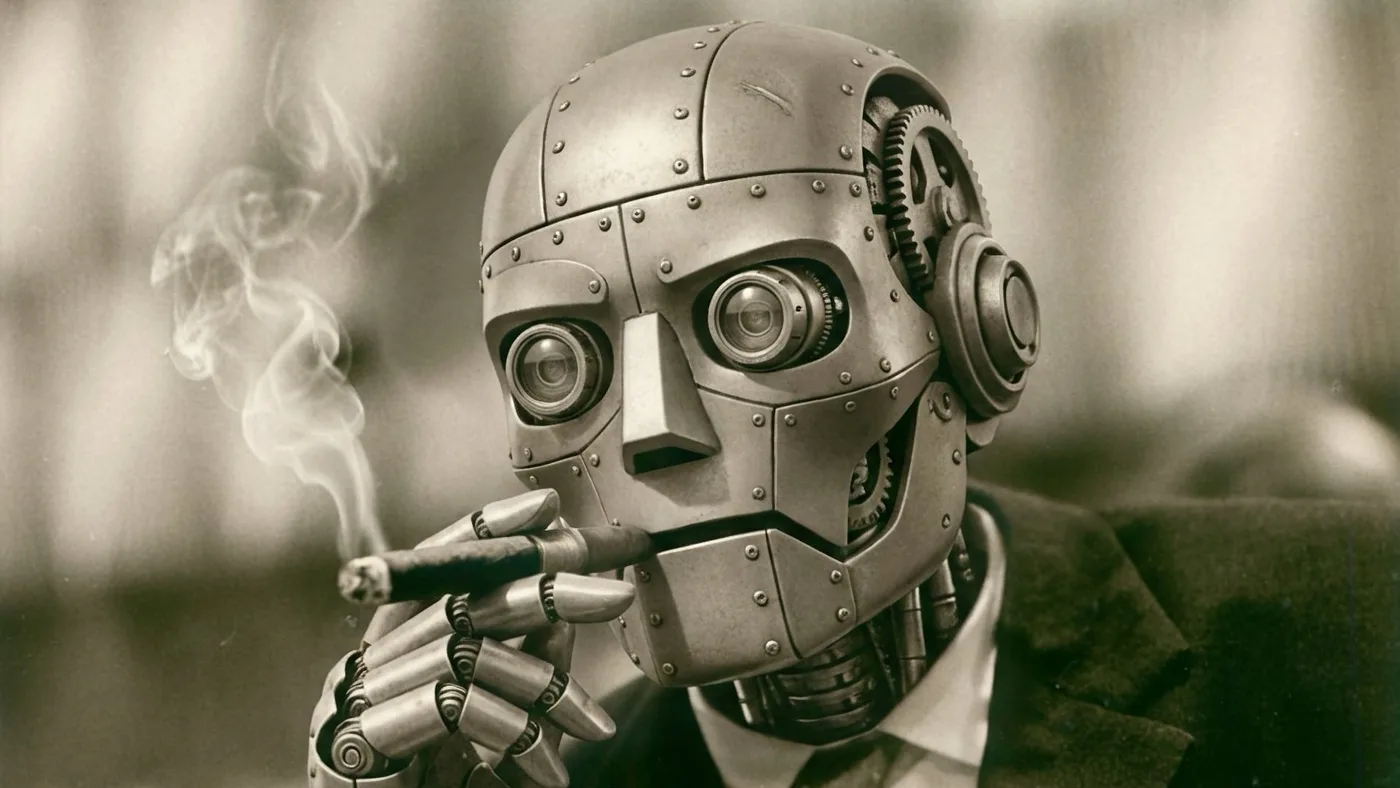
Perhaps the biggest risk isn’t hunger but meaninglessness. If an AI not only codes faster but is also the more empathetic therapist, the more attentive partner and the wiser adviser, what’s left for humans? We risk becoming well-cared-for “pets” of our own creation. (Does anyone know where I stole the banner image from? 😉)
Conclusion: Society’s “Innovator’s Dilemma”
Let’s come full circle back to Clayton Christensen. His lesson was brutally honest: companies don’t die because they’re stupid. They die because they realise too late that the foundations of their success have shifted. They perfect what already exists (the blue line) while relevance has long since moved to the red curve.
Today we face a situation in which Christensen’s logic no longer applies only to corporations, but to our social structures.
Our education systems, our social security systems and our understanding of “work” are the equivalent of Kodak or Blockbuster. They are optimised for a world that runs in a straight line. If we keep improving these systems only incrementally (a posteriori) while the AI reality grows disruptively, these structures won’t merely “come under pressure”. They will become obsolete.
If Dario Amodei’s “Genius Nation” becomes reality, we won’t have time for an adjustment phase spanning generations. The danger is real that our society shares the fate of the former market leaders: we could slide into irrelevance because we clung to old recipes for success while the rules of reality had long been rewritten.
What we need now are leaders and politicians with the courage to make a priori decisions.
We have to put safeguards for human dignity and new concepts of value creation in place before the data proves they’re needed. Anyone waiting for the market to sort it out is making the classic mistake of the Innovator’s Dilemma. Except this time, it’s not a share price at stake, but social cohesion itself.
If we’re too sluggish, we could become the Kodak of civilisational history ...
Part 2 of this trilogy
Schwarzenegger vs. Keynes - Consequences of the Social Innovator’s DilemmaDocIsInDaHouse
Part 3
2026: The Tipping Point of the Social Innovator's DilemmaDocIsInDaHouse