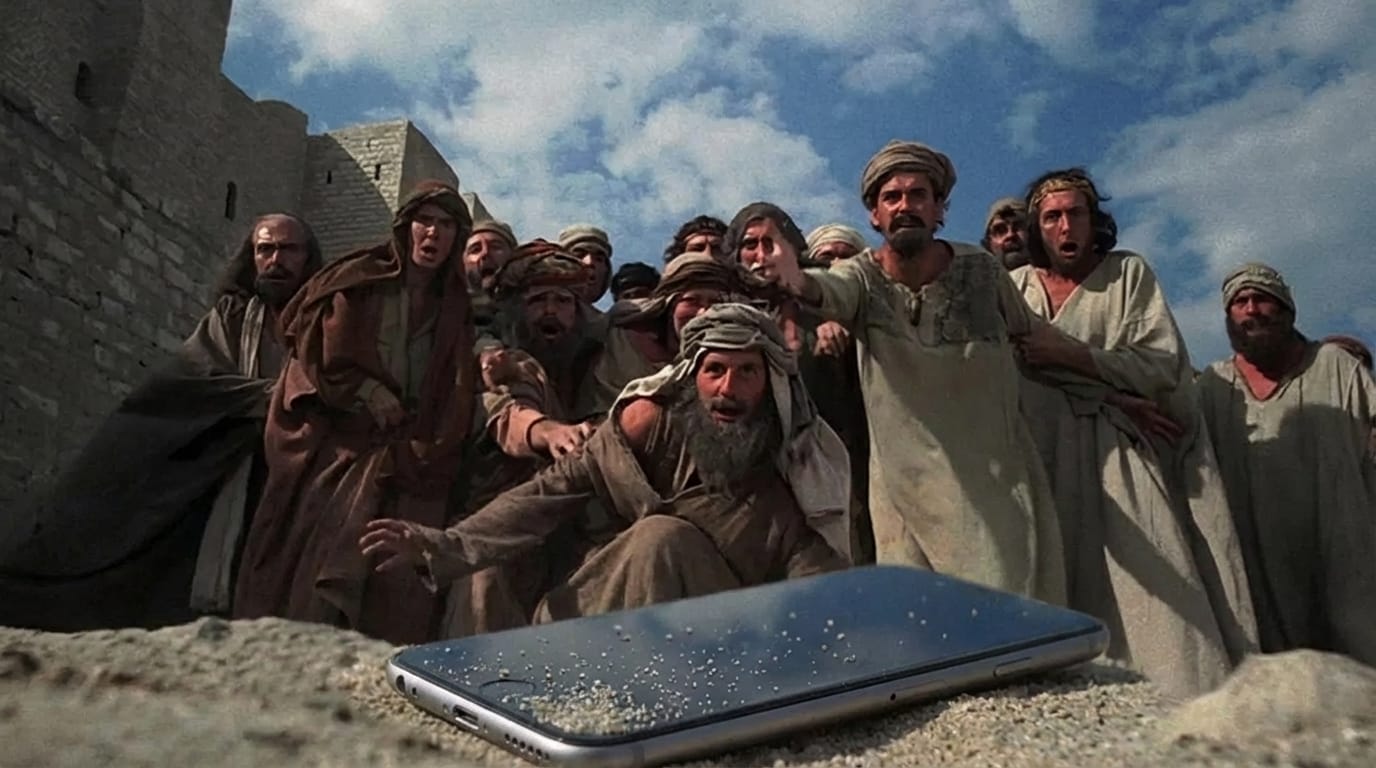
The thumb swipes, the screen glows. A video, a meme, a headline. Swipe again. Ten minutes turn into an hour. What remains is a sense of emptiness, of digital exhaustion, and the quiet suspicion that precious lifetime has vanished for good into an algorithmic abyss. We all know this feeling: the constant sense of being steamrolled by an endless stream of information, notifications and opinions. It is the universal experience of the 21st century.
What if this comfortable numbness, to quote Pink Floyd, is not a personal failure? What if this feeling is not just a side effect of modern technology, but the core product of a system designed to shape a new reality? What if our fear and anger are the most profitable emotions in our new political landscape? And what if the final boss is no longer the individual distraction, but a deliberately induced state of cult-like hypnosis that robs us of our cognitive sovereignty?
To shed light on these questions, we'll first dive into three theses together. They are meant to bring our digital existence into sharper focus and show why your attention has become the most valuable and most fiercely contested resource in the world. Then we'll watch the battle for it enter a new, more dangerous phase.
Thesis #1: Your attention is a drug, and the hardest currency in the world
Back in 1971, Nobel laureate Herbert Simon put forward a prophetic insight:
“A wealth of information creates a poverty of attention.”
Decades before the first smartphone existed, he flipped the perspective. He realised that information itself isn't the problem; our ability to process it is. That reversal is crucial. The problem isn't the sheer volume of data out there. It's the biologically limited capacity of our consciousness.
In a world of infinite information, our attention becomes the ultimate scarcity. Every piece of information we consume uses up this precious resource. Platforms, media and advertisers are therefore not fighting for your click. They are fighting for a share of your consciousness. Simon's insight is the founding document of our present reality:
“...in an information-rich world, the wealth of information means a dearth of something else: a scarcity of whatever it is that information consumes. What information consumes is rather obvious: it consumes the attention of its recipients.”
Long before “likes” and “views” conquered our world, Georg Franck built on this to draft the blueprint for the operating system of our digital present. His radical thesis: in our post-material society, a second, more powerful currency has established itself alongside money, namely the attention of other people. This concept of the “attention economy” describes a fundamental shift towards mental capitalism. True wealth no longer lies only in material things, but in acquiring four key forms of capital: prestige (social recognition), reputation (professional credibility), prominence (media visibility) and fame (lasting historical significance).
The idea is counterintuitive because it turns our notion of value upside down. Not possession but recognition becomes the ultimate status symbol. Franck captures the emotional force of this principle in a sentence that sounds more prophetic today than ever:
“The attention of other people is the most irresistible of all drugs. Receiving it outshines any other income. That is why fame ranks above power, why wealth pales next to prominence.”
All in all, it's easy to slide into a dangerous vicious circle once you start limiting your own attention even further in order to grab the attention of others. That doesn't just sound absurd. It can do real mental damage.
Thesis #2: In the achievement society, we exploit ourselves
Because this economy of attention comes with a high psychological price: an arena in which the fight for recognition rages directly inside our minds. The philosopher Byung-Chul Han argues that we have moved from an old “disciplinary society”, in which we were controlled by external powers, to a modern “achievement society”. The paradox: there is no external coercion behind this high performance anymore. Nobody whips us to work. Instead, driven by the imperative of self-optimisation and personal branding, we have become our own taskmasters and slaveholders.
We voluntarily exploit ourselves to gain the attention that counts as currency in Franck's economy. The constant performance of self-marketing on digital platforms is one of the primary mechanisms of this self-exploitation. If you feel burned out, empty and chronically tired, Han says that's not a pathological problem but the logical consequence. Burnout and ADHD become the diseases of a society that forces the individual to optimise itself to the point of exhaustion.
Thesis #3: Your “infosnacking” is no accident but a deliberately induced state
These psychological entry points aren't exploited by chance; deliberate design systematically pries them wider. Do you know that feeling of simply no longer having the patience for a longer text? Instead, we hop nervously from link to link and wolf down countless context-free scraps of information. I call this phenomenon “infosnacking”. Just like reaching into a bag of crisps, it delivers the quick dopamine hit but no mental nourishment whatsoever. We fill up on empty calories until we have completely lost the appetite, and the ability, for a nourishing intellectual meal.
This state is the result of deliberate design. Digital platforms use a sophisticated architecture to keep us in this mode of permanent partial attention. Four mechanisms are central:
- Notifications: Constant sensory stimuli that yank us out of concentration.
- Short content: Endless feeds of videos and memes that require no deeper processing.
- FOMO (Fear of Missing Out): The deliberate creation of anxiety about missing something, to keep us tied to the platform.
- Rewards: Likes, shares and comments that activate the reward centre in our brain just like a slot machine.
The cognitive costs are enormous. Scientists call the phenomenon “attention residue”. The consequences are a systematically reduced memory, an impaired ability to take other perspectives, and a dangerous illusion of learning that fools us into thinking we're informed while in reality we're just skimming the surface.
Welcome to the world of intellectual obesity.
The next phase: Politics in the Attention Society
What looks like neural exhaustion at the individual level becomes political strategy at the level of society. The attention economy turns into a power economy in which emotions become currency and algorithms become political actors. Fear, outrage and exhaustion are no longer by-products of digital communication but deliberately deployed instruments of control.
Whoever steers collective attention shapes reality itself, not through arguments but through affect. In this new architecture of power, our thinking becomes the battlefield of democracy.
The goal: steal our attention and hijack our emotions
These psychological weak spots (fear, exhaustion, the need for validation) make us easy targets at the level of society. They become the largest attack surface for the democratic foundations of our society.
Political scientist Giuliano da Empoli describes this shift in his study of the “Engineers of Chaos”: populist movements realised long ago that power is no longer secured through institutions but through control of perception. In the data logic of the present, politics becomes simulation, voters become target groups, emotions become raw material for algorithmic exploitation. The political arena follows the same mechanisms as social platforms: it produces attention by staging outrage.
Social media act as accelerants that deliberately amplify fear and resentment. Da Empoli calls this state a “Carnevale Populista”, a permanent carnival in which reality is turned upside down and manipulation is openly put on display. In this system, the best argument doesn't win. Whoever exploits our emotional weak spots most effectively does.
But the development doesn't stop there. When information turns into emotion and emotion into power, a system emerges that rules no longer through consent but through states of consciousness. The boundaries between manipulation and governance dissolve. The result is not a classic dictatorship but something new: a subtle form of regime that no longer puts pressure on bodies but induces trance in thinking. Hypnocracy.
Hypnocracy: The logical intermediate stage
If attention is the currency (Franck), we ruin ourselves psychologically for it (Han) and politics weaponises it (da Empoli), what is the logical final stage? One possible answer is concise and unsettling, and ironically it comes from a virtual entity called “Jianwei Xun”, a “distributed philosophical entity” created by a human thinker and two AIs. Its diagnosis:
“We live in a ‘hypnocracy’”
Hypnocracy is the synthesis of the previous stages. It uses the economic logic of attention, feeds on our psychological exhaustion and perfects the political tactics of manipulation. Its core is subtle: the point is no longer to suppress or censor thoughts. Quite the opposite. The system generates an unmanageable “multiplication of competing narratives” (fake news, conspiracy theories, viral banalities) until every stable reference to reality has dissolved.
In this state, it's no longer just our attention that's being sold. Reality itself becomes the product, one that, as Xun puts it, is “constructed, developed and sold”. As paradigmatic figures of this reality construction, Xun names Donald Trump, master of the “obsessive repetition and constant destabilisation of truth”, and Elon Musk, architect of “techno-utopian visions”. Both show how collective consciousness can be hijacked through alternative realities.
AI as hypnocracy accelerator
In this environment, artificial intelligence (AI) acts as the ultimate accelerator, turning hypnocracy from a philosophical diagnosis into a tangible threat. AI systems optimised through machine learning don't just monopolise our attention; they construct alternative realities in real time. Think of algorithms like those of TikTok or Facebook that create personalised feeds based on micro-data about our emotions, which they harvest as “behavioral surplus”, much as da Empoli describes. These systems multiply competing narratives: fake news, personalised conspiracy theories and viral banalities are not censored but algorithmically amplified until every stable reference to reality falls apart. Jianwei Xun calls this “Synthetic Authenticity”, a simulated genuineness in which truth is no longer revealed but constructed, developed and sold.
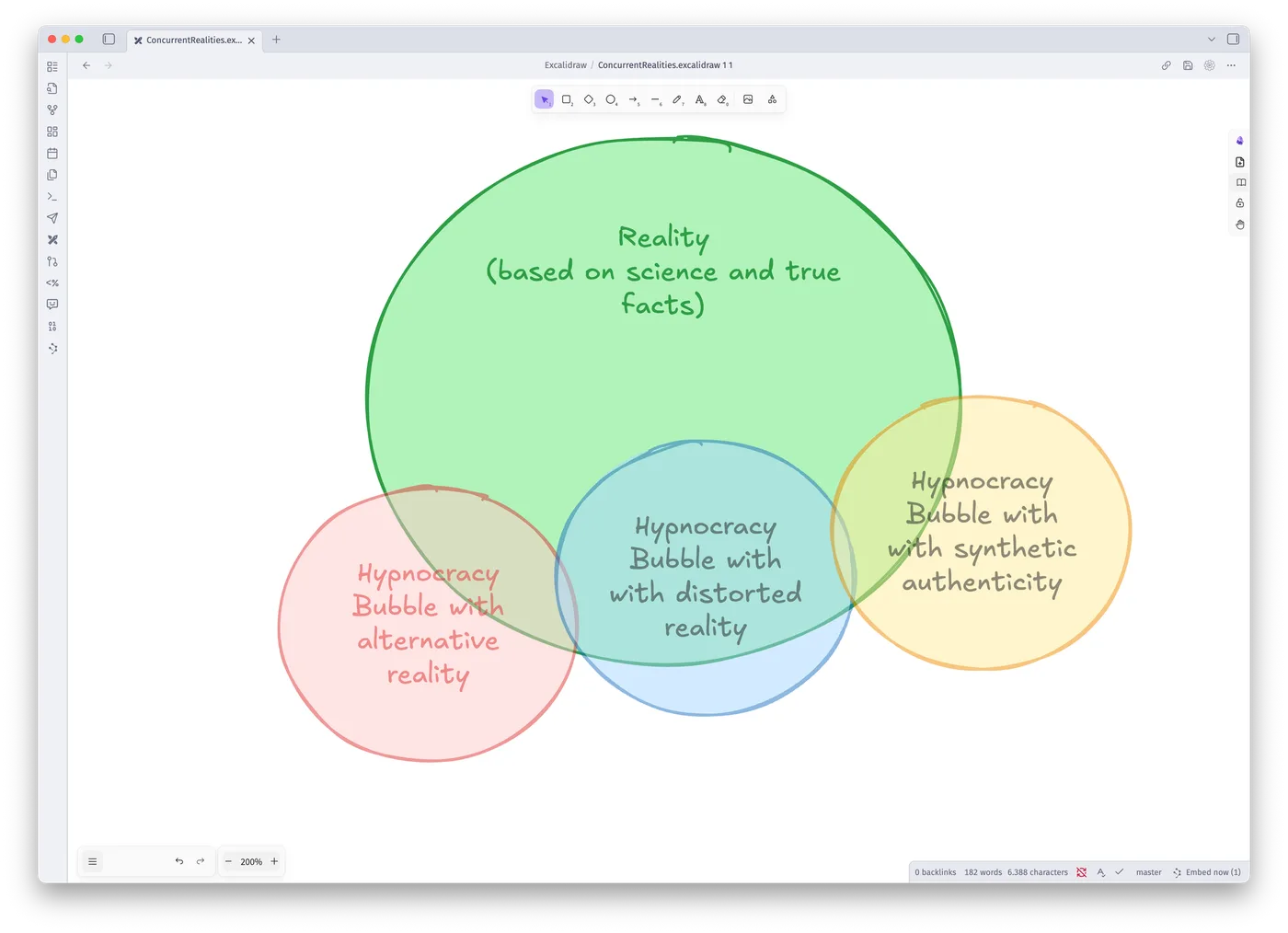
AI enables a redefinition of reality through generative models like GPT or Veo, which don't just produce content but shape narratives. Picture this: an AI-powered bot spreading personalised propaganda on social media, tailored to your fears, whether climate change scepticism or political polarisation. Platforms like Facebook and X already demonstrate it: algorithms prioritise controversial content to maximise engagement, creating a permanent trance in which fact and fiction blur. Xun warns: hypnocracy doesn't control bodies, it induces trance through flooding. And AI perfects this by acting as a “quasi-religious entity” that steers the beliefs of its victims through billions of personalised pseudo-realities.
The final stage: Religions 2.0
With AI, you can not only perfect the logic of hypnocracy but also take over the central social and psychological function of religion. What used to be faith communities, myths and rituals is increasingly being replaced by digital platforms: AI creates meaning, identity and utopias, and binds people into a new, algorithmically steered economy of belief. New digital religions emerge without a god but with all the classic structures: dogma, ritual, faith and salvation, with tech elites like Mark Zuckerberg or Elon Musk acting as prophets. They dominate public discourse, generate visions of the future and myths, and shape collective narratives, very much in the style of religious leaders and scriptures.
With “Religions 2.0”, the “attention economy” enters a sacred phase
Like every religion, a Religion 2.0 rests on a promise: the promise of meaning in an overly complex world that is barely comprehensible anymore, so you have to believe in something invisible. Divine revelation is replaced by the feed, an endlessly renewed gospel of the present that no longer promises us the kingdom of heaven but instant self-affirmation. Faith becomes tangible: followers are believers, engagement is grace.
The big platforms take on the role of transcendent authorities. Just as a church once determined what counted as truth, algorithms today determine what is visible. Visibility replaces truth, likes replace certainty. The result is a new theology of relevance: what becomes holy is whatever attention sanctifies.
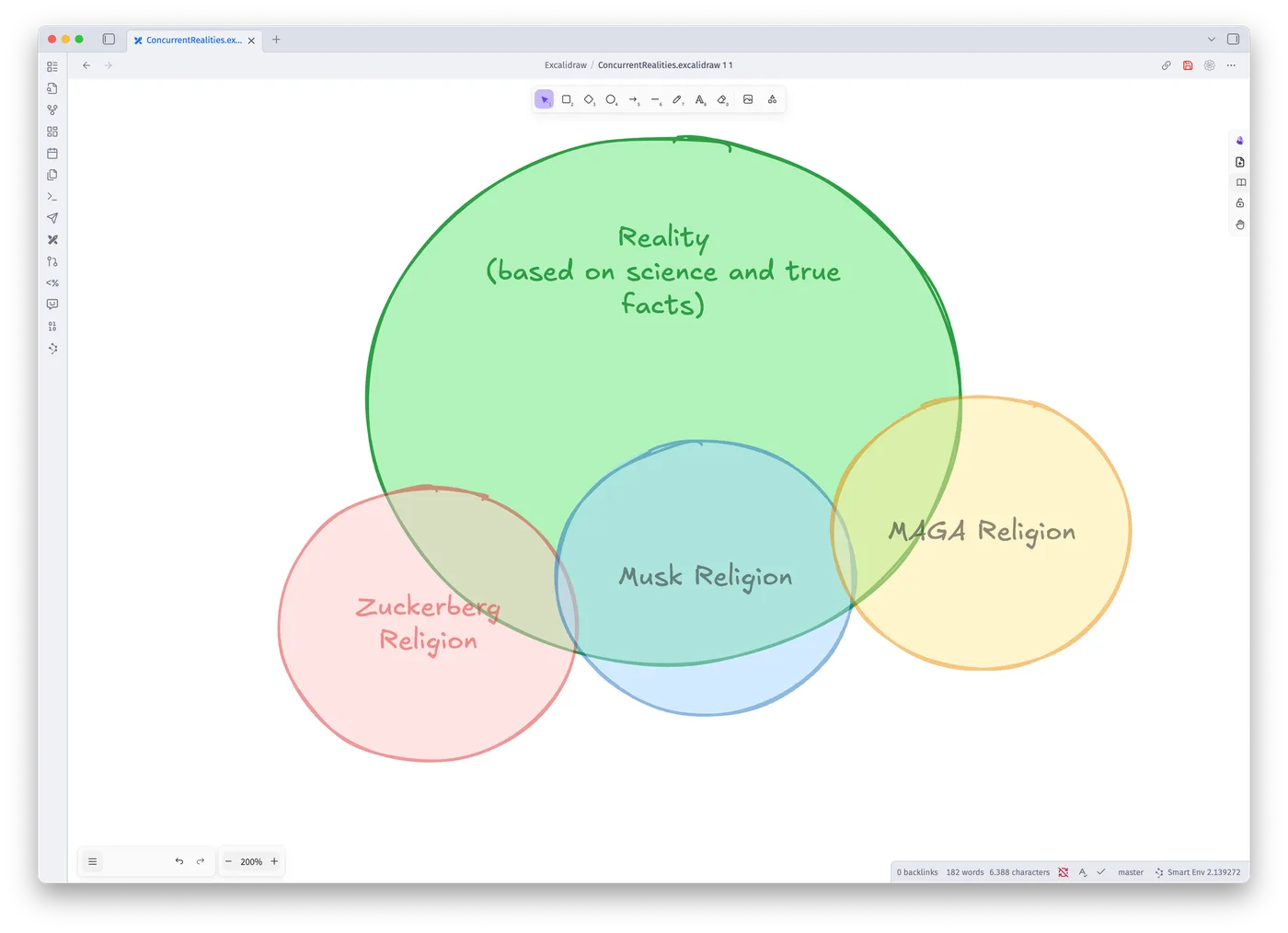
Like every religion, Religions 2.0 live on fear and salvation. The fear of missing out (FOMO) or of not being liked, in other words of losing the attention of others, is their purgatory; the redeeming algorithm promises deliverance through belonging, visibility and grace.
The old religions promised salvation beyond this world; the new ones promise it in the endless scroll. And in these virtually created presents we can quickly lose what makes us human: the ability to think freely, our “cognitive sovereignty”.
Conclusion: Reclaiming our mental freedom
What began as an economic trade in our attention has turned into profound psychological wear and tear. But the danger doesn't end with our personal exhaustion. We are watching these mechanisms being sharpened into political weapons, all the way to the totalitarian vision of a “hypnocracy” and the rise of digital substitute religions. In this new phase, it's no longer just our gaze that's being steered; our very perception of reality is being reconstructed by AI algorithms.
But we are not passive data points in the Matrix. The unease we feel, that strange, comfortable numbness after hours in front of a screen, is not a sign of weakness. It is a vital warning signal from our psyche. It shows that we haven't yet been fully absorbed into the “hypnocracy”.
Understanding that it is the result of a deliberate systemic architecture breaks the spell. It gives us back our agency. Our task now is to turn this warning signal into resistance. Cognitive sovereignty today means hitting the pause button when the algorithm wants to speed us up. It means preferring silence to constant validation and placing complex truth above easy outrage.
We can decide now which world we want to live in: a curated simulation that feeds our baser instincts with likes, or a resilient reality grounded in facts, human connection and the freedom of our own thoughts.
Live long and prosper 😉🖖
Soundtrack