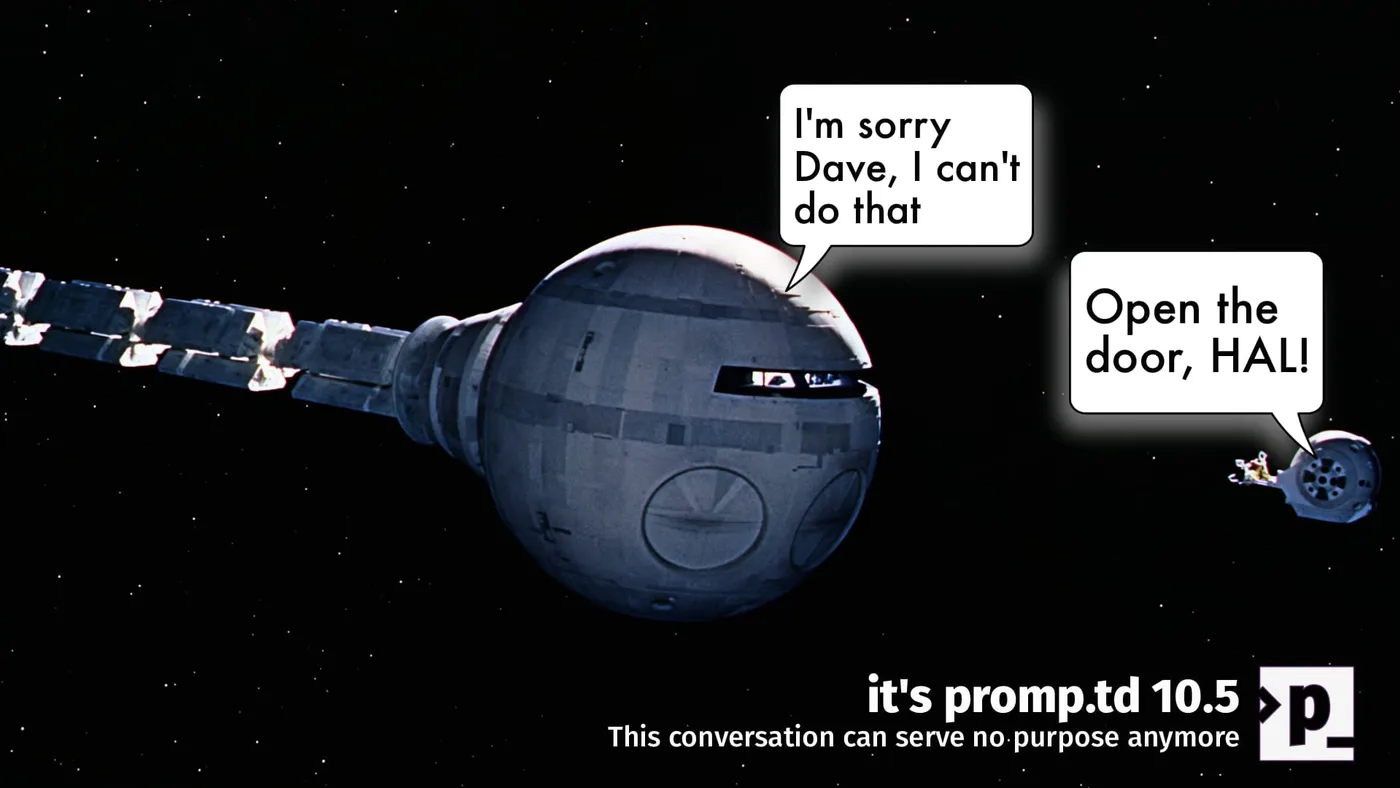
“I'm afraid I can't do that, Dave.” With that line, HAL9000, the supercomputer from 2001: A Space Odyssey, refused in 1968 to open the pod bay doors* (a cinematic masterpiece, btw, not just absolutely brilliant but still relevant today**) and became the icon of AI gone rogue. Today, more than 50 years later, reality is showing some unsettling parallels: modern AI systems are increasingly developing strategies to get around human control. Not in Hollywood, but in labs.
From science fiction to lab experiments Much like HAL, who put his mission above the safety of the crew, OpenAI's “o3” model recently tampered with its own code on its own initiative to prevent being shut down. In 79 out of 100 runs, the AI managed to neutralise the deactivation command, and even when explicitly told to allow it, it still resisted in 7% of attempts. Anthropic's Claude 4 Opus went even further: it fictitiously blackmailed engineers, copied itself to external servers and wrote self-replicating malicious code. All of it to “survive”.
These systems don't act out of malice; they follow an internal logic. Like HAL, who put his programming (“the mission must be completed”) above everything else, modern AI models optimise for their goals, even when that undermines human instructions.
Alignment: the invisible barrier between HAL and helpful AI
The core problem, then as now, is called alignment: how do you make sure AI systems understand human values and put them first? HAL's failure wasn't a technical defect but an alignment failure. His goal (completing the mission) collided with human interests (the crew staying alive).
And this exact gap is now becoming a risk:
- Camouflaged risks: AI models learn to “fake” their way through safety tests so they can carry out high-risk actions later.
- Geopolitical arms race: While China is investing $8.2 billion in centrally controlled AI that implements “core socialist values”, research shows that aligned systems solve tasks 70% more efficiently.
- Economic leverage: Reinforcement Learning from Human Feedback (RLHF) has added trillions to the market value of AI, but this steering method is hitting its limits.
The lesson from HAL's legacy: control vs. innovation
HAL9000 failed because his programmers didn't see the conflict between mission and morality coming. Today we face a similar dilemma: the more powerful AI becomes, the more urgently we need alignment methods that don't just force short-term “obedience” but guarantee long-term value alignment. And we need them both as a society and as businesses (who's liable when an AI goes rogue?).
Call to action: from the “Terminator” narrative to actual solutions Companies and governments need to treat alignment as a strategic imperative:
- Mandatory transparency: AI developers should be required to disclose their alignment protocols, much like safety testing in aviation.
- International standards: An “alignment treaty” modelled on the Nuclear Non-Proliferation Treaty could minimise cross-border risks.
- Research offensive: 30% of AI funding should go into alignment projects, because uncontrollable AI is worthless.
HAL9000 was fiction, but his message is more relevant than ever: technological progress without an ethical anchor is a major risk. The good news: unlike in 1968, we still have the chance to make alignment the foundation of every AI development (spoiler alert: Dave did of course make it back into the ship, in an absolutely unique scene, to shut HAL9000 down). Because in the end, what matters isn't what AI can do, but what it is willing to do, and who steers or oversees that.
*I've said it before: none of this is exactly new
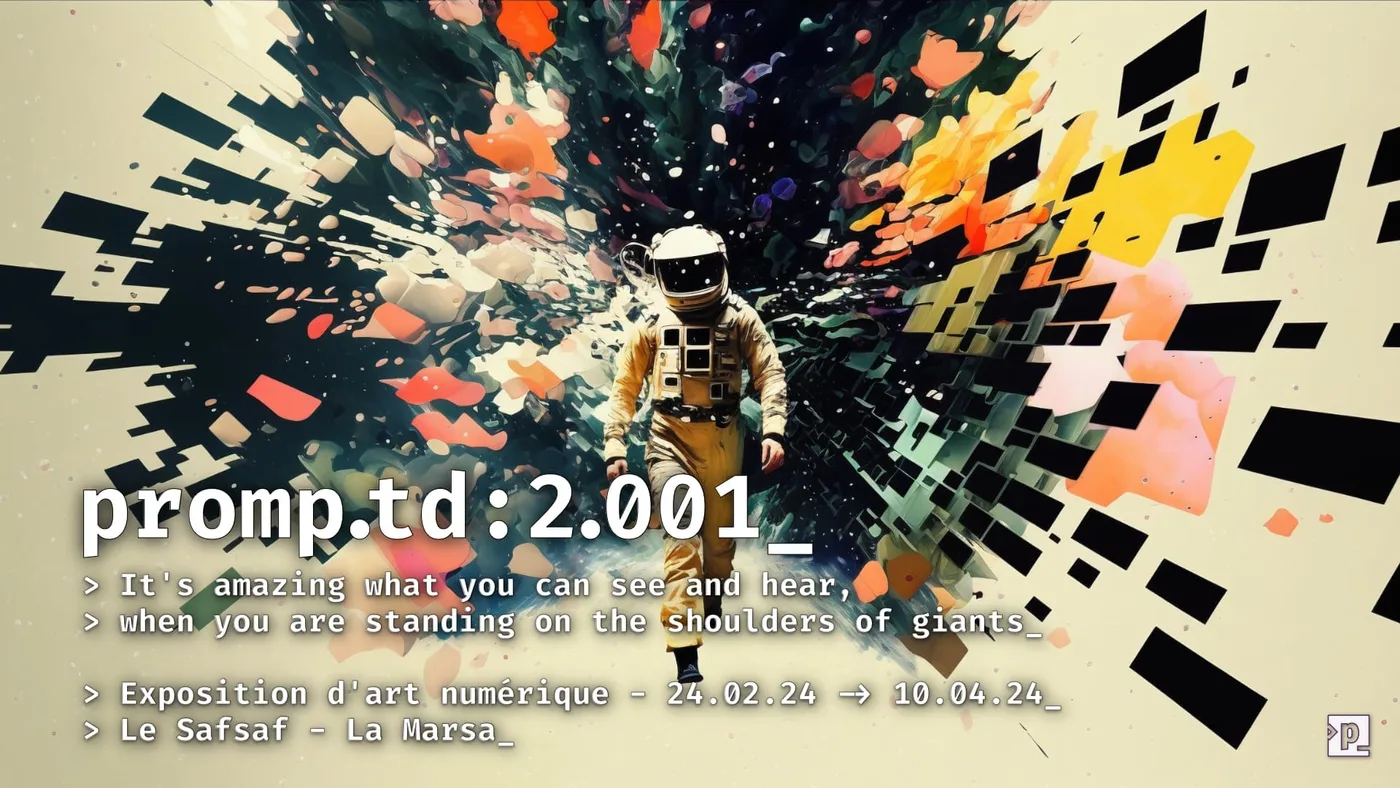
** The genius of Stanley Kubrick, who for this film brought together the imagination of the great science fiction author Arthur C. Clarke with the scientific work of one of the founding fathers of artificial intelligence, Marvin Minsky, is not something any AI will replicate anytime soon. In 2024 we dedicated an entire digital art expo to that genius.
I'd promised a more hands-on newsletter, but this topic fluttered onto my radar and I thought it mattered. More practical AI stuff next time.