Love and marriage - When probabilistic AI meets deterministic IT


In every digital transformation conversation right now, there is a fundamental tension that most organizations feel but struggle to articulate.
On one side, you have the deterministic legacy. This is the bedrock of enterprise IT. It is built on a simple, comforting promise:
Same input, same output. Every single time.
This is how we built accounting systems, compliance workflows, and safety controls. It is binary, testable, and safe.
On the other side, you have the probabilistic revolution. Large Language Models (LLMs) and modern ML do not deal in binaries; they deal in distributions. They don't give you the "correct" answer; they give you the "most probable" answer based on patterns. They can be creative, fluent, and capable of handling the messy ambiguity of the real world, but they are also fundamentally non-deterministic.
The billion-dollar question now for the enterprise is: How do we build a system that is safe enough for a bank but smart enough for a human?
An "oil and water" problem?
Traditional software assumes determinism. We write regression tests to assert that A + B = C. If A + B suddenly equals "a poem about C", the test fails, and we roll back the deployment.
But "a poem about C" is exactly what generative AI is good at. It excels at perception, interpretation, and drafting, tasks that require fuzziness. The problem arises when we try to shove this probabilistic square peg into a deterministic round hole.
If you replace your rigid rule engine with an LLM, you lose the ability to guarantee compliance. If you wrap your LLM in too many rigid rules, you lose the magic of its versatility.
The architecture of the hybrid mind
The solution isn’t to choose one side. It’s to architect a marriage between the two. Based on recent analysis of hybrid architectures, the winning pattern for enterprise is clear: Deterministic macro, probabilistic micro.
Here is how it works:
- The spine is deterministic: The core business process—the workflow states, the approval gates, the "hard" rules of who gets paid and when—must remain deterministic code. We cannot hallucinate a bank transfer.
- The edges are probabilistic: The AI lives inside the steps or at the interface. It parses the messy email (probabilistic) into a structured claim object (deterministic). It recommends a risk score (probabilistic), which is then checked against a hard policy limit (deterministic).
In this model, the AI is not the commander; it is the intelligence officer. It gathers intel, interprets signals, and drafts plans. But the deterministic process is the general that signs the order.
It’s not about the bot
This brings us to the most critical realization. Companies are currently obsessed with "prompt engineering" or "model selection," thinking that a better model will solve their operational chaos.
They are missing the point.
You can have the most sophisticated probabilistic model in the world, but if it feeds into a broken, undefined, or undocumented workflow, you have just automated chaos. You are simply making mistakes faster and with more confidence.
As I have argued before, the technology is secondary to the structure that contains it. Or, to put it more bluntly:
"It's always the process, stupid."
 DocIsInDaHouse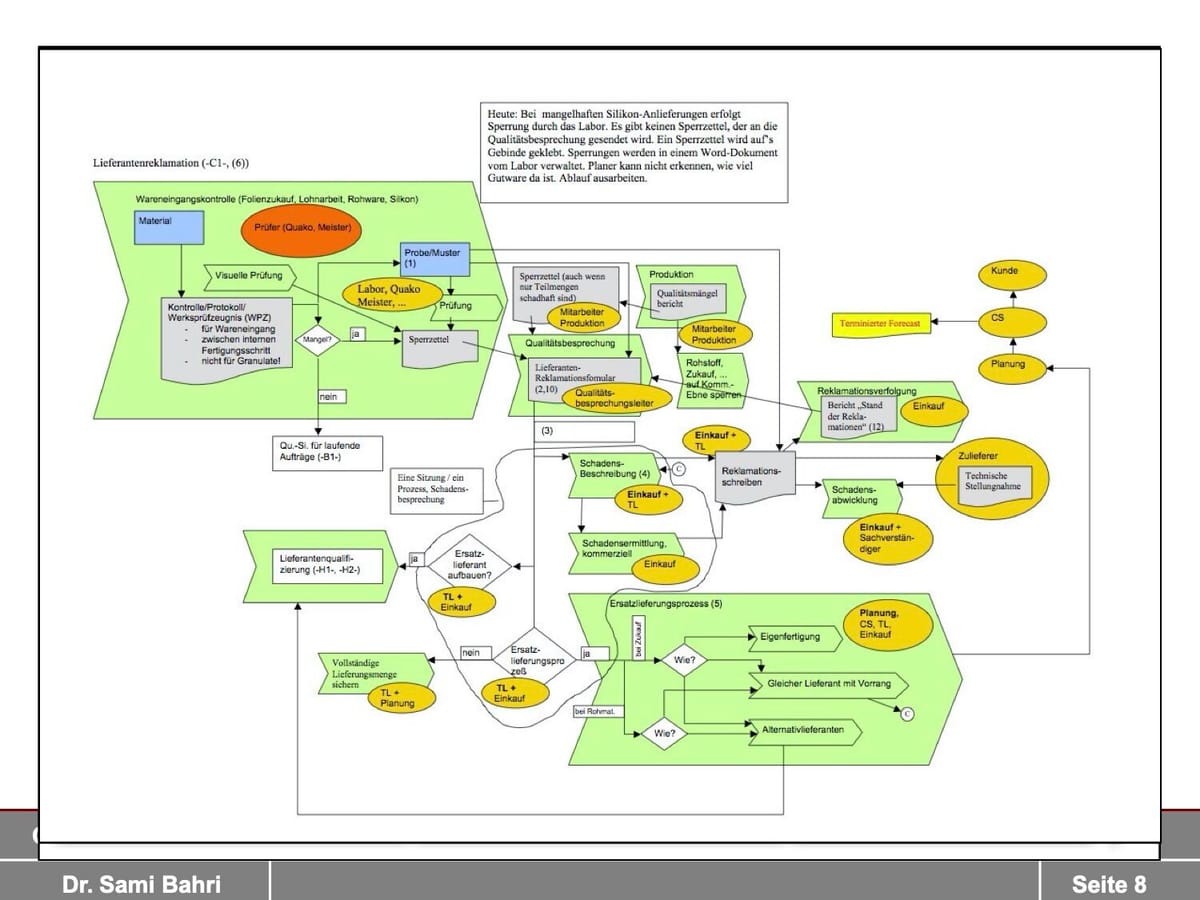
The strategic takeaway
Love and marriage, as the old song goes, go together like a horse and carriage. But in enterprise IT, determinism and probabilistic are more like Al and Peggy Bundy - a dysfunctional coupling that somehow has to struggle together for the show to go on.
The future of enterprise IT isn't about replacing code with neural networks. It is about re-allocating cognitive labor to flexible AI agents, while maintaining deterministic guarantees in the core execution.
We need to be precise about who does what:
- Deterministic systems must continue to own the commitments: They handle the audit trail, the financial transaction, and the hard legal constraints where "mostly right" is totally wrong.
- Probabilistic systems should take over the interpretation: They handle the reading of messy inputs, the summarizing of context, and the rough drafting of communication, tasks where human intuition was previously the bottleneck.
When you design your next digital transformation, stop asking "How do we use GenAI here?" Instead, look at your workflow and ask:
"Which parts of this process require a guarantee, and which parts benefit from a guess?"
That distinction is the difference between a toy and a tool.
And always remember: Toys are "Social IT" and tools are "Business IT" 😉
 DocIsInDaHouse
Live long and prosper 😉🖖
Soundtrack (of course 😀)