The previous article ended on an open question: the individual centaur may well be able to save himself, but who will pay for the stable? We have followed Schumpeter's creative destruction as it climbed the building. First it went through the knowledge worker's desk, then through the company's processes. Now we have reached the top floor: the state, and with it the entire social contract.
The first article in this series described AI as an interior designer with a slight taste for arson: able to rearrange the rooms, but also to go after the load-bearing walls. We know which ones it has already shaken: the worker's methods and the company's processes. One wall remains, the last one, the one our collective solidarity rests on: human labour as the source of social funding.
Our social contract runs on a circuit so familiar that nobody spells it out anymore. Labour creates value. That value is split into wages and profits. Wages and profits feed taxes and social contributions. Taxes and contributions pay for schools, hospitals and pensions. In Tunisia, this circuit has concrete names: CNSS, CNRPS, CNAM. Every Tunisian worker's payslip quietly irrigates the system.
But the circuit assumes that value creation runs through human labour. That is exactly the condition AI is starting to erode.
You could mistake this for a simple accounting problem: a shrinking tax base, revenue to be found elsewhere. That would underestimate it. What is cracking is the mechanism that gave birth to the social contract in the first place, and its funding cracks along with it.
To see this, we need to call on an economist you may not expect to find in this series.
From exploitation to irrelevance: what Marx didn't see coming
You don't need to be a Marxist to recognise that Marx described the mechanics of his era correctly. We use him here the way we used Schumpeter and Drucker: for his lens, not his programme. In August 2026, the German weekly Der Spiegel ran the cover line “Dare more Marx?” and asked whether AI would kill capitalism. When the question reaches the newsstands of Hamburg, it deserves to be asked in Tunis.
A quick refresher on the mechanics. The capitalist invests: he buys machines, raw materials and human labour power. At the end of the cycle, the goods are worth more than the wages and factories cost. That difference is profit, and it lets capital accumulate.
But the worker gains something too, and that is where the magic formula of modern societies hides: those who work are rewarded. A wage, a shot at social mobility, dignity, a place in the world. The system holds as long as it produces wealth and enough people who benefit from how it is shared. Marx saw this capitalism as antagonism. But the antagonism concealed an interdependence. Capital exploited labour, yet it needed labour: labour power was the source of value. A factory without workers produced nothing.
This mutual dependence drove the social history of the 20th century. Because capital needed the worker, the worker had bargaining power: a strike only hurts if you are needed. That friction, not the kindness of capital, is what wrung out the historic compromises: trade unions, Bismarck's social insurance, the welfare state, Ludwig Erhard's social market economy. In Tunisia, it shaped decades of social dialogue between the state, the employers and the UGTT.
The worker, exploited or not, had a seat at the bargaining table because nobody could do without him.
Marx predicted that capitalism carried the seeds of its own end: to survive competition, companies must keep becoming more productive, automate, squeeze costs, and gradually push living labour out of production. Written in 1867, it reads uncannily like a description of the 21st century.
But right now the story is taking a turn, and it is getting more unsettling.
When capital (compute, models, intellectual property) becomes able to produce cognitive work at scale, the worker does not move from exploitation to liberation. He risks moving from exploitation to irrelevance. Cognitive work, once paid in wages and social contributions, is now billed in tokens: the kilowatt-hour of cognitive labour.
And irrelevance is more fragile than exploitation. The exploited can negotiate: he can withdraw his labour, and that withdrawal has a cost. The irrelevant can no longer negotiate: his withdrawal costs nothing. All he has left is to ask nicely.
Marx feared that capital would exploit the worker. The question he didn't anticipate is more unsettling: what becomes of the worker once capital no longer needs to exploit him?
MIT labour economist David Autor draws the political conclusion: a society would be “very hard to sustain in a world where most people no longer have anything to offer.” The social contract rests on redistribution, yes, but also on the fact that everyone has something to contribute, and therefore something to bargain with.
Two observations make this worse.
The first concerns the theory of value. For Marx, all value came from labour. Yet AI models have been trained on accumulated human labour: decades of texts, code, analyses and expert decisions. We saw in the second article that experts' decisions become training data: at Bridgewater, the real asset was not the document but the judgement attached to it. Thomas Piketty speaks of a “gigantic appropriation”: AI companies take other people's knowledge and experience and try “to put a property title on it.”
A Marxian reader would recognise a new form of extraction here. Surplus value is no longer skimmed off labour power rented hour by hour. It is captured once, then replicated endlessly, wage-free. The worker is no longer employed precisely because his know-how has already been absorbed.
The second concerns the means of production. Marx proposed socialising them, and whatever you think of the idea, factories were physically located and could be seized. Digital means of production cannot: datacenters abroad, models duplicated across several continents, intellectual property parked in carefully chosen jurisdictions. Even a state that wanted to take back control would find nothing to seize. This asymmetry outlines, by elimination, the only sovereignty still within reach.
History has a sense of irony. Marx predicted the concentration of capital and the impoverishment of the masses. The 20th century proved him wrong thanks to the interdependence of capital and labour, which forced sharing. Digital capitalism could make his prediction come true through a different mechanism: not because capital exploits labour too much, but because it stops needing it.
The economic consequence fits in one sentence, and it will be the red thread of this article:
If human labour is no longer the primary means of creating value, it cannot remain the primary means of distributing wealth.
For Tunisia, this has a painful ring to it. Our middle class was built in part when foreign companies outsourced their work and Tunisia managed to capture a share of that flow: Law 72, IT services, engineering, accounting, customer service. We built careers, contributions and tax revenue on the offshoring of other people's work.
So the Tunisian worker risks being hit twice. As a worker, by the automation of his tasks. As an outsourcing destination, by the European client who no longer needs to outsource. The destruction happens in Tunis; the value creation concentrates in a datacenter in Frankfurt or Virginia.
And a GPU in Frankfurt or Virginia pays nothing into the CNSS or the CNAM. So the problem is not patching up a tax base. It is rebuilding a bargaining table that is losing one of its historic legs: the need for human labour.
The temptation to respond with yesterday's tools will be strong. Let's see why they probably won't be enough.
Why yesterday's answers won't do: the innovator's dilemma, state edition
Faced with this diagnosis, the natural reflex is to tweak a rate, create a tax or widen a contribution. But states may be about to make a mistake companies know all too well.
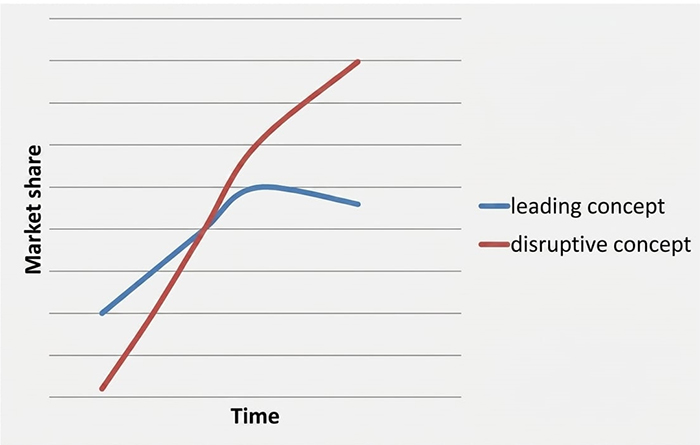
Our tax and social security systems are institutional Kodaks. They are remarkably optimised for an economy of formal, salaried, localised work. Every parameter has been fine-tuned for decades. But optimising a system designed for a disappearing world doesn't save it. It just makes it more efficient on a trajectory that ends at a wall.
On top of this dilemma comes a problem of method. Immanuel Kant distinguished a posteriori knowledge, drawn from experience, from a priori knowledge, built through reasoning before experience.
Our institutions operate almost exclusively a posteriori. We manage water scarcity after the shortage, debate reforming the social security funds once their deficits have become structural, regulate economic activities after they have slipped into the informal sector. We drive towards the future with our eyes fixed on the rear-view mirror.
As long as change was slow, the method held up. The farmer's son became a factory worker; his grandson, a developer. Society had generations to adapt.
AI brutally compresses that timeline. The automation of cognitive work, the silent shrinking of headcounts and the relocation of destruction unfold over years, sometimes months. The farmer had a generation to retrain. Does the 40-year-old Tunisian engineer have five years? Probably not.
The Tunisian trap is narrower still. A state with fiscal headroom can absorb a few years of mistakes. Tunisia, with a narrow tax base, a large informal economy and strained public finances, doesn't have that luxury. A cruel paradox: the countries that most need to think a priori are the ones least able to afford the mistakes of a posteriori.
So let's set aside three answers that will inevitably come back in the debate. They fail on target, scale or timing.
The naive robot tax: wrong target. The intuition is appealing: if the machine replaces the worker, let it pay contributions in his place. But a badly designed tax would first hit Tunisian companies in the middle of their transformation, without ever reaching the international platforms whose models run abroad. We would penalise our local centaurs and spare the global Trojan horses. Worse: we would push our companies to consume foreign AI rather than develop it locally.
Digital autarky: wrong scale. Build everything locally, cut ourselves off from international platforms. As we said in the second article, autarkic sovereignty would be as expensive as it is illusory. No country the size of Tunisia can replicate the infrastructure of the hyperscalers.
Waiting for proof: wrong timing. This option, the most comfortable one, never presents itself as “doing nothing”. It goes by waiting for things to become clearer, letting the studies conclude, watching what others do. It is a posteriori dressed up as prudence.
But the usual indicators won't show anything until it's too late. Silent downsizing leaves no immediate trace in layoff statistics; it shows up later, in unemployment among graduates looking for jobs that were never created. Waiting for proof means choosing to act a posteriori.
And doing nothing is not neutral. While a country deliberates, its partners automate, its talent emigrates to better-prepared ecosystems, and the rules of digital taxation get written without it.
Christensen also showed the way out of the trap: build the new alongside the old, rather than waiting for the old to reform itself. That is the path worth exploring.
Rethinking the tax base: real-world lessons and a decisive distinction
If yesterday's tools won't do, where should we look? Two international experiences (an instructive failure and a lesson in humility) followed by a proposal will help us draw out the distinction that structures our scenarios.
Abilene, or the illusion of infrastructure
Abilene, a mid-sized Texas city, lived through the double blade described in this series: hundreds of office jobs eroded by automation, then the arrival of a multi-billion-dollar datacenter. The authorities celebrated the investment. Then construction ended.
What remained was a facility consuming large amounts of electricity, water and land, and permanently employing somewhere between 50 and 100 people. Far fewer than the jobs destroyed.
The balance sheet is cold: the value created by computation is exported globally, while the costs (strained grids, consumed resources, rising rents, vanished jobs) stay local. The city hosts the means of production of the 21st century without capturing their value. In the United States, support for building datacenters has collapsed, by the way, while local protests are multiplying.
The lesson: hosting is not enough. A datacenter is not a 20th-century factory with thousands of workers on the payroll. Without a pact negotiated before the building permit, it pumps local resources to produce extraterritorial value. Abilene negotiated a posteriori. In other words, not at all.
The OECD, or the necessary humility
For more than a decade, the major powers have been trying to tax the digital economy: “GAFA” taxes, OECD negotiations to reallocate taxing rights and introduce a global minimum tax.
The results are mixed: slow implementation, disappointing yields, geopolitical power plays. If the European Union, with 450 million consumers, struggles to make the platforms contribute in proportion to the value they capture, Tunisia must avoid two illusions: believing it can impose its own terms alone, or believing that waiting for a multilateral solution exempts it from acting. It will be a rule-taker, following rules written elsewhere. All the more reason to act where it has real room to manoeuvre.
But where?
Updating the social market economy: the New Social Digital Economy
I propose what I call the New Social Digital Economy, an update of the social market economy for the age of AI.
Its principle: some resources are too essential for access to depend solely on purchasing power. They call for a dual system, in which a basic public infrastructure coexists with private supply without claiming to replace it.
Let's apply this principle to the critical resource of our time: digital intelligence. Just as electricity has its kilowatt-hour, it has its own unit of measurement and billing: the token. Every query, analysis or line of generated code is counted and paid for in tokens. Anyone who watches their cloud bill knows it: the token is the kilowatt-hour of the 21st century. And whoever has no access to it, or only at prohibitive prices, is economically and socially left behind.
A dual system would rest on three pillars:
- basic intelligence coverage: public compute capacity serving schools, local authorities, startups and displaced workers;
- a local digital dividend: private datacenters contribute to a regional retraining fund, negotiated at the building permit stage;
- a thermodynamic symbiosis between the infrastructure and its territory.
A datacenter physically turns electricity into tokens, and into heat. Upstream, Tunisia has a comparative advantage: one of the richest solar resources in the Mediterranean, at the very moment energy is becoming the main cost and bottleneck for datacenters. The Tunisian solar kilowatt-hour can become a competitive token. Downstream, server heat can feed local uses: agricultural greenhouses, food drying, low-temperature desalination, hot water for hospitals and hotels.
Sunlight goes in, tokens come out, heat goes back to the territory: the infrastructure slots into a cycle in which the territory becomes a stakeholder. This dual system is the classic Christensen answer: build the new alongside the old.
And Tunisia has already played this score. And won.
In the 1960s and 1970s, a young country with limited resources faced a massive infrastructure deficit. The state didn't wait for the market to electrify the countryside: it built the power plants, rolled out the grid, brought electricity and drinking water all the way to the villages. STEG and SONEDE weren't born from a short-term profitability calculation, but from a conviction: some infrastructure is the precondition for everything else.
The state also kick-started sectors before opening them up. In tourism, the initial public investment in hotels, infrastructure and training created the conditions for a private sector that became a pillar of the economy. The state didn't run tourism forever: it carried the initial risk, proved viability, then let private initiative take over.
A public datacenter is the power plant of the 21st century. Its output is no longer measured in kilowatt-hours, but in tokens. The logic is the same: capital-intensive infrastructure that makes an ecosystem possible. The startup that cuts its compute bills, the school that trains on real infrastructure, the administration that keeps its sensitive data on national soil, the displaced worker who finds a space to reinvent himself. Nobody asked the power plant to turn a profit in five years. It was asked to electrify the country, to make possible what wasn't.
The historical lesson cuts both ways, though: the kick-starter state succeeded when it knew how to kick-start and then hand over, and disappointed when it dug in as a permanent manager. A “digital power plant” will have to learn both halves of the lesson: initial boldness, and a gradual withdrawal in favour of the ecosystem. But the token is just the equivalent of a 220-volt current. A power plant only matters through what gets plugged into it; a datacenter, through the knowledge that grows on it. Hence the central distinction of this article.
Infrastructure sovereignty, decision sovereignty
“Digital sovereignty” covers two different realities.
Infrastructure sovereignty means owning the physical means of computation: datacenters, chips, networks, foundation models. It's the one everybody talks about, and the one that, in its global version, will remain largely out of reach. Investments run into tens of billions and are concentrated among a handful of players. Tunisia's digital power plant won't compete with Virginia: its job will be to guarantee access, not dominance.
Decision sovereignty means owning what gives the token its value: domain data, expert judgement, usage rules, the choice of problems, and guardrails. The second article showed this at company level under the name Intelligence Ownership: at Bridgewater as at Shopify, the edge came less from the size of the datacenter than from the quality of the knowledge fed into it. The third showed it at individual level: value is shifting towards framing, verification and arbitration.
A bridge has emerged between these two sovereignties.
The global AI race is producing two business models. On one side, proprietary systems: closed, available for rent, token by token. The customer never acquires the intelligence; he subscribes to it. On the other, open-weight models, published by American, Chinese or European players: downloadable, hostable locally, adaptable. This openness isn't philanthropy, it's competition: the challengers gain in influence what they don't earn in subscriptions.
Who wins doesn't matter here. The consequence is decisive: high-level digital intelligence can become an available good, not just a service for rent. A capable open model can run on national infrastructure, be adapted to Tunisian data, and operate without any sensitive data leaving the country.
So the strategy isn't about picking a side, but about deliberate diversification: rent proprietary intelligence where it excels and the data isn't sensitive; build on open intelligence where sovereignty matters: administration, health, finance, strategic knowledge. Mapping, decision by decision, what can be rented and what must be owned: the exercise we recommended to companies, scaled up to the national level.
This kind of sovereignty is within Tunisia's reach. It depends less on gigantic budgets than on what the country already has: domain knowledge in finance, health, industry and tourism; familiarity with European, African and Arab markets; graduates whose versatility could become a comparative advantage in the age of AI.
What remains is to turn these principles into concrete options. None of them will be enough on its own.
A few scenarios for a new Tunisian social contract
These directions aren't a single recipe but complementary options. They share one goal: to rebuild institutionally the interdependence the economy no longer produces on its own. If the need for human labour no longer guarantees citizens a seat at the bargaining table, we have to build them other chairs.
Scenario A: fiscal adaptation, or shifting the base
Since value is escaping the labour tax base, the idea is to capture it where it still passes through the territory: at the point of consumption. Concretely, a tax on the consumption of imported tokens. Not to discourage it, but so that local use of foreign intelligence contributes to local solidarity. We have always taxed imported energy, and nobody bats an eye. Market-access conditions could complement this approach: a foreign operator wanting to serve Tunisian banks, telecoms or administrations could be asked for something in return, in training, data localisation or know-how transfer.
This scenario has the merit of realism and the flaw of its limits. Tunisia's digital tax base is narrow and the yields will be modest. Above all, making AI more expensive risks slowing down the very transformation we are encouraging among companies and workers. Getting the dose right will be tricky: tax the passive use of imported intelligence without penalising productive investment. A necessary scenario, but an insufficient one.
Scenario B: the digital power plant, or the token as a common good
The second scenario picks up the logic of the kick-starter state: a public compute infrastructure, sized not to compete with the hyperscalers but to guarantee access. If cognitive work is now paid in tokens, we might as well produce some of them at home, and route the ones from elsewhere through public infrastructure.
The digital power plant would therefore have a dual function.
The first would be to produce compute capacity locally, notably based on open models hosted in Tunisia. Its beneficiaries would be the ones the market serves poorly: the school training the centaurs of 2035 on real infrastructure; the startup prototyping without burning its capital on cloud bills; the administration processing its sensitive data locally; the displaced worker finding a non-commercial space to reinvent himself.
That last point answers the Gen Z Dilemma raised earlier: how do you train tomorrow's experts if the machine absorbs the tasks people used to learn on? We called for spaces for hands-on learning, even if less efficient in the short term. The digital power plant could fund them and let the next generation learn to frame, verify and arbitrate.
Its second function would be to serve as a gateway to the major international models. Part of Tunisia's token consumption could pass through this public plant, which would buy capacity from global providers and then redistribute it to companies, administrations and individuals.
Here the electricity analogy shows its full strength. A national power plant never meant cutting the grid off from the world: it produces locally but stays connected to international networks to import when needed. The digital power plant could work the same way: hosting open models and sensitive data on national soil, while providing access to the best foreign proprietary models when their performance justifies it.
This gateway would also make the taxation envisaged in Scenario A far more workable. Instead of trying to track down, after the fact, countless transactions between Tunisian users and foreign platforms, the state could measure, aggregate and tax token consumption at the gateway. The digital power plant would thus be not just a public producer of intelligence, but also a grid operator and a tax meter.
This mechanism would make it possible to differentiate uses: subsidised access for education, research, public services and early-stage startups; standard rates for productive uses; a specific levy on certain volumes or commercial uses. It would also provide leverage for collective bargaining with the big international providers. A national or regional buyer of tokens would carry more weight than a crowd of Tunisian companies negotiating separately.
This centralisation must not, however, become either a mandatory monopoly or a surveillance tool. Companies should be able to contract directly with foreign providers when their needs require it. The plant would rather be a public reference route, with advantages in price, compliance, sovereignty and tax simplicity. The data processed, the volumes consumed and the purposes of use would have to be strictly separated: metering tokens to bill or tax them must not mean inspecting the prompts.
Two further conditions apply. First, scale: the project may require pooling at Maghreb or African level. Tunisia has what it takes to initiate it: geographic position, submarine cables, solar potential and human capital. Second, governance: to avoid becoming an expensive, underused public facility, the plant will have to meet measurable targets, publish its results and gradually leave competitive services to private players, while keeping its core missions of access, sovereignty and interconnection. A power plant is judged by what it powers and how well it connects, not by its installed capacity alone.
If international datacenters one day set up in Tunisia (a plausible scenario, given the sun, the proximity to Europe and the saturation of northern sites), the lessons of Abilene must be applied a priori: a local dividend negotiated before the permit, capacity reserved for public use, heat put to work, and interconnection with the digital power plant. A pact, not a windfall.
Scenario C: decision sovereignty as industrial policy
The third scenario means elevating Intelligence Ownership to a national strategy. If general-purpose models know “the world's average” but not the exception that makes a profession, the knowledge accumulated by Tunisian companies and institutions is a deposit of value. Finance compliant with regional regulations, healthcare in a Maghreb context, knowledge of European, African and Arab markets, bilingual or trilingual law and accounting: all fields where specialised models, trained on local expert decisions, can outperform the generalists, as Bridgewater and Shopify demonstrated with resources nowhere near those of the hyperscalers.
The industrial policy would consist of organising this deposit: helping companies turn their institutional knowledge into specialised models and exportable augmented services; making the state the first testing ground, by building the administration's Intelligence Ownership instead of renting generic foreign intelligence indefinitely; positioning Tunisia not as a subcontractor for tasks AI is absorbing, but as a supplier of knowledge the big models don't have.
This scenario closes a loop opened at the start of the series. The first article asked whether Tunisia would become a producer of solutions, an exporter of augmented services, or a mere consumer of technologies designed elsewhere. Scenario C maps the path to the first option. But it requires the centaurs, the Creative Generalists and the verification skills described in the previous article. No decision sovereignty without humans capable of deciding. Here, industrial policy and education policy are one and the same.
The three scenarios fit together: A funds modestly, B equips, C adds value. A without C degenerates into punitive taxation; B without C builds a power plant with nothing to plug into it; C without B leaves the talent without power. Combined, they can sketch out a viable social contract.
Beyond taxation: the question of distribution
That leaves the hardest question: if Tunisia captures a share of the value created by digital capital, what do we fund, and how do we distribute it?
The international debate offers three main options. Universal basic income, championed even in Silicon Valley, sometimes by the very people doing the automating, who would rather keep consumers solvent than share capital. Universal basic services: guaranteeing not a cheque but access to healthcare, education, transport and, tomorrow, tokens. Finally, universal basic capital, advocated notably by Nicolas Berggruen: giving citizens not allowances but shares in a fund fed by the companies profiting from AI, along the lines of Singapore or Australia's funded pension system. Universal income turns the citizen into a beneficiary; universal capital turns him into a shareholder, someone who owns a piece of the economy as it transforms, and has something to bring to the bargaining table.
For Tunisia, an order of realism applies. A universal income is out of reach budget-wise. Universal basic services extend the country's history; the digital power plant of Scenario B would be a new form of them. As for universal capital, it could inspire a modest version: if a public fund kick-starts Tunisia's AI ecosystem, why shouldn't part of its future profits go back to the citizens whose data and knowledge fed it?
This series still has one open debt: how do we recognise the contribution of workers whose decisions become training data? If the expert's judgement is the real asset, then the person whose judgement trains a model deserves a share of what it earns. The 20th century invented wages and social contributions to pay for repeated work. The 21st may have to invent the equivalent of a copyright on captured judgement. That is what a rebuilt seat at the bargaining table could look like.
Conclusion: steer or be steered, state edition
The capitalism Marx described rested on an interdependence: capital needed labour, and that need forced the compromises our social contracts are made of. Digital capitalism dissolves that need, threatening to push the worker from exploitation into irrelevance, and the state from redistribution into powerlessness.
Yesterday's answers, tweaking rates, waiting for proof, will fail on target, scale or timing. But options exist: shift the tax base, build the digital power plant, make decision sovereignty an industrial policy, and reinvent distribution, all the way to paying for judgement itself.
None of this will happen by itself. All of it requires what Kodak lacked: the clarity to see the disruptive curve while the old one is still making money, and the courage to build the new alongside the old.
The previous article argued this for the knowledge worker: the one variable he still controls is not whether the transformation will happen, but who will steer it. The same conclusion holds for the state. The transformation of Tunisia's social contract will happen, by choice or by erosion. It can be steered a priori, by a country that has already proven it can build the infrastructure of its era before the market sees the point. Or it will be endured a posteriori, dictated by foreign clients and tax rules written elsewhere.
A society is not measured by the productivity of its machines, but by what it decides to do with the humans they free up. It is also measured by its ability to keep them at the bargaining table, not out of nostalgia, but by deliberate design.
The individual centaur can save himself. The stable won't pay for itself. But Tunisia still has what it takes to build it: it may not be able to match the horsepower of the giant datacenters, but it has the riders. Above all, it still remembers being a builder state, one that knew how to invest in its future instead of waiting for the market to feel like it.
Epilogue: the Centaur test
The deeper I dig into the equation this new technology poses, the more one conviction takes root: the nations that come out of the AI revolution as winners won't necessarily be the ones fielding the most gigantic technological or financial resources. They will be the ones that manage the decisive step of transforming how they create and distribute wealth. Only on that condition will their human capital avoid becoming obsolete and remain a genuine engine of their prosperity. Intellectual transparency also obliges me to make a confession to close this series. These four articles are themselves the product of centaur work, exactly as I described it. I defined the framework, the structure, the central ideas and the concepts, then steered the writing and corrected the execution using several artificial intelligence tools. AI as Ghostwriter. The torso set the strategy, the horse supplied the speed. It is now up to the reader to judge whether the result is relevant, and whether it is any good.