We've already got used to AI painting pictures, composing music or producing video. But what about other forms of human creativity, the more practical kind, say in software development? Can AI produce not just art, but also build software? I've already described in this post why LLMs, the foundation of these AI systems, are practically made for code
Claude 4.5 Sonnet: The first AI developer that can code for 30 hours straightClaude 4.5 Sonnet sets a new benchmark in software development: a coding AI that plans, programs and tests autonomously for hours on end. It shows how AgenticAI is making the leap from tool to digital development team, and rethinking entire processes along the way.DocIsInDaHouse
That said, my previous “vibe coding” tests hadn't really convinced me. But in an environment this dynamic, you have to keep re-examining your scepticism and regularly ask whether it still holds up against how fast things are moving.
Naturally, that question was on my mind when I was developing the Digital Competence & AI-Enablement Mini-MBA together with the German Business School: a four-day intensive programme designed to get experienced project managers ready to use AI in their day-to-day work.
Why I started the experiment
Building digital competence plays a central role in the course. We use various assessments to gauge each participant's level of maturity and tailor the learning paths accordingly.
The tools available for this, though, were inflexible, barely visual and hard to link up with course data (classic office tools that you have to feed and adjust by hand, with a lot of effort). So the idea came up to build our own application for running and comparing assessments individually.
I wanted a system where participants don't just see their own learning progress, but where trainers can also tailor workshop content more precisely to each group.
Important: I may be an experienced project lead for digital transformation, but I'm no programmer. I wanted to find out to what extent the latest generation of AI assistant tools can actually carry a complete development process, with me steering purely on the business side.
From prompt to app
At its core, the development was a classic AI dialogue (aka prompting), much like creative AI applications in music or visual art. I described user roles, workflows, logic, design and so on, and had AI agents generate and deploy the code.
Every component, from user management and registration and login to data management and progress comparisons, was prompted and largely generated automatically.
I set the requirements, gave feedback, iterated, like a director working with his camera crew. Except this “crew” consisted of AI agents tirelessly delivering new versions within minutes. Sometimes very good ones, but sometimes things went sideways and I had to point out their mistakes to these “agents” and restore the context so they could carry on (yep, the context, again and again)
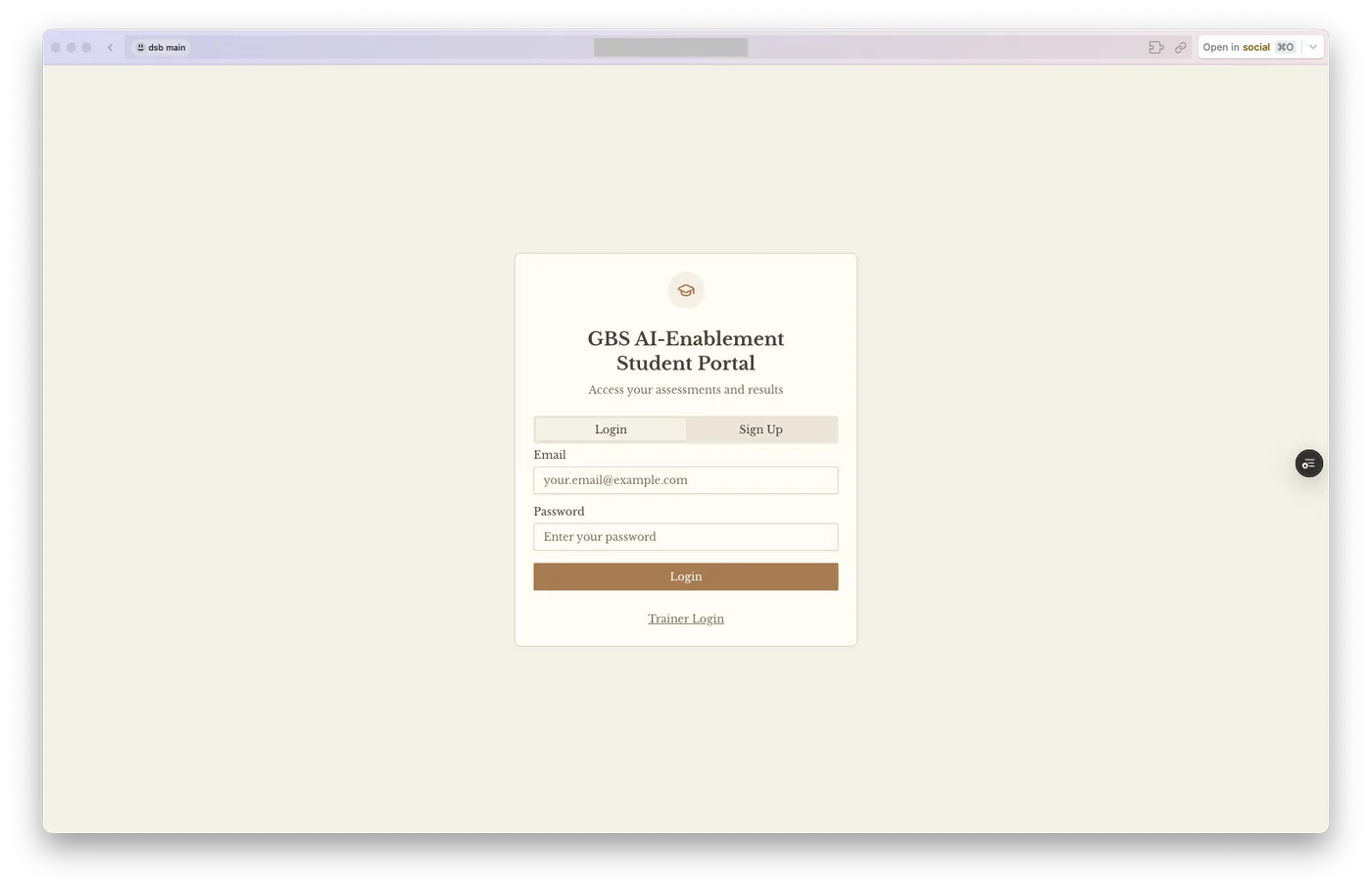
(Video) A quick look at the application
The following video shows the application, developed as a companion tool for the AI-Enablement Mini-MBA. The screencast shows both the participant view and the trainer dashboard.
What the application does, without being AI itself
The app itself contains no AI features (yet). Its purpose is to document digital learning processes and make them traceable.
- Participants can run their own assessments, compare results and make their progress visible across several sessions.
- Trainers and coaches have access to the data and can adapt content to the maturity level of their groups.
The goal is for everyone to be on the same page by the end of the workshop, i.e. “AI-ready” in the best sense.
What I noticed while building it
In the video I say: “The whole thing was programmed by an AI, but under my direction.”
And that sums up the key point: I had a clear idea of what should come out of it, but the operational work, writing, testing and deploying the code, was done by AI agents. And of course I have experience steering larger development teams, so I understand a fair bit about how software development processes work.
That's probably the biggest parallel to creative work with AI tools in other fields: just as musicians conduct moods or designers shape compositions, as a project manager you become the creative conductor of the software process. The AI agents become the orchestra, and it plays as soon as you know what music it's supposed to be.
Learning curve and reality check
From idea to finished, stable application took about 3 days, counting pure working time. In a classic project, that would probably have needed a small development team and at least a week.
Of course there were mistakes, loops and warm-up phases. But the core was in place quickly, and the quality of the result honestly surprised me. The current state of development certainly still has room for improvement, but here's what matters most: this tool is miles better than the tools we had. The entire process (assessment -> learning flow -> assessment) is far better optimised and lets us train participants faster and better. That's exactly why you need and build software (yep, coz' it's the process, stupid 😉 )
So the project was not just a demonstration of technical feasibility
but yet another lesson in the new division of labour between human and machine for optimising work processes.
Bottom line
For me, this little experiment was a practical stress test of what we also teach in the AI-Enablement Mini-MBA: how to use digital tools strategically, assess them thoughtfully and turn them into real value for yourself and the people you work with.
The application is not (yet) a technical masterpiece. These systems still have their limits, but those limits are being pushed back faster and faster.
So if there's one area where AI can replace staff in the relatively near term, it's IT.