
Over the past few months I've sketched two concepts here. In spring it was the “institutional blindness” of off-the-shelf AI: the models know the internet, but not your company. In August came the economic bill. Anyone who rents back their own corporate knowledge through a “prompt tax” on every API call loses money in the long run.
Today we need to talk about the dark side of that coin. What happens when the AI is not forgetful? When it learns exactly what it isn't supposed to learn: your most valuable, most intimate lines of thought, your strategic “quiet judgment calls” and your half-finished breakthroughs?
Welcome to the territory of structural intelligence theft. Forget hackers in black hoodies. This is about the perfectly legal, everyday use of AI APIs. And a brand-new case from cutting-edge research is illustrating the problem right now with a force that should make every company sit up.
The situation: when the assistant becomes the competitor
The problem boils down to one uncomfortable premise: if you use a hosted frontier model (GPT, Claude or Gemini) to crack your toughest nuts, you may well be training your provider's algorithm, and with it, potentially, your future competition.
We outsource our heaviest cognitive lifting to “black boxes”. We feed them context, correct their mistakes and use precise prompting to show them the right way. We think we're using a tool. In truth, we're the unpaid R&D department of Big Tech.
Just how ruthless this mechanism can look in practice is shown by the current uproar over the Navier-Stokes problem.
The real-world case: the Navier-Stokes incident
The Navier-Stokes existence and smoothness problem is no niche academic topic. It is one of the seven Millennium Problems in mathematics, and the Clay Mathematics Institute has put up one million US dollars for its solution. The equations describe the flow of liquids and gases. Whoever solves them writes scientific history.
NYU mathematician Tristan Buckmaster and his colleague Levent Alpöge (employed by Anthropic in his day job, but doing private research here) were quietly working on exactly that. They chose an extremely rare, unconventional mathematical path (the so-called “smooth force” tactic). For their work they made heavy use of Codex, OpenAI's coding AI model.
On 8 September 2026, Buckmaster published first, promising proofs. Shortly afterwards came the shock: out of nowhere, OpenAI announced a complete solution to the entire problem.
The explosive part is in the details:
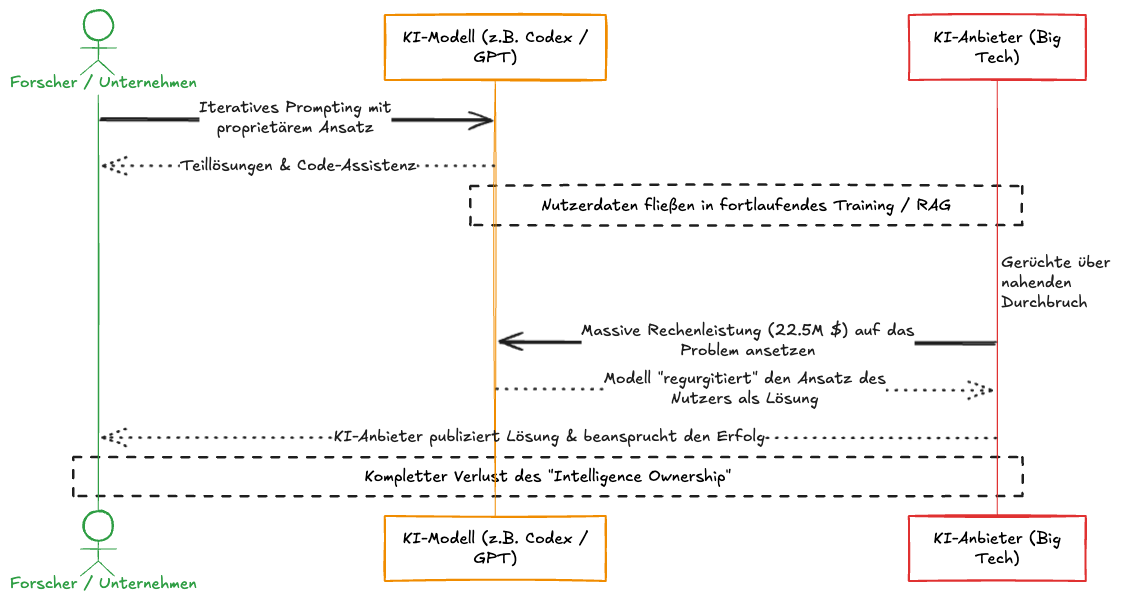
- The approach: OpenAI's AI chose exactly the same extremely rare, exotic solution path as Buckmaster.
- The resources: OpenAI had an unreleased next-generation model crunch for a week at a cost of 22.5 million US dollars (300 billion output tokens), motivated, according to the company, by “market rumours” of an imminent solution.
- The conduct: When Buckmaster pushed back, he says OpenAI researchers threatened him (“Why do you want to ruin your career?”), paired with a request to remove his colleague Alpöge (who conveniently works for competitor Anthropic) from the publication.
OpenAI rejects the accusations: it says it never saw Buckmaster's unpublished work and never deliberately extracted any specific user data. The model, it says, solved the problem on its own.
Analysis: the architecture of expropriation
OpenAI's defence may even be technically true, and that is precisely what makes the situation so dangerous. We need to look at different scenarios of how proprietary knowledge diffuses through APIs.
It's unlikely that an OpenAI engineer manually read through Buckmaster's chat logs. The reality of modern LLMs is subtler: models learn from aggregated, “de-identified” user interactions. When a brilliant researcher spends days forcing a model down an exotic mathematical path, the weights shift in the background. The model learns the path. When an internal research team at the AI provider then gives the model a similar task, it simply spits the freshly learned knowledge back out. Or, in AI jargon: it regurgitates it.
It's essentially Borg assimilation from Star Trek, cast in the mathematics of neural networks: the intellectual distinctiveness of the individual is inevitably added to the collective.
The following sequence diagram makes this asymmetric relationship visible:
Why this case is so illustrative
Three patterns deserve attention because they generalise:
1. The asymmetry of the burden of proof. Buckmaster has to prove that his knowledge was extracted, against a black box whose training data nobody can inspect. The provider only has to claim it worked independently. Whoever controls the weights also controls the truth about where they came from. That's exactly what I meant in March by opacity as a structural problem.
2. The asymmetry of resources. Two researchers versus 22.5 million dollars of compute. Once the direction is known (and the direction was Buckmaster's real intellectual achievement), the rest becomes a computing exercise. In other words: the most valuable part of intellectual work today is no longer the execution, but the judgment about which path is worth taking. Exactly the “quiet judgment calls” from the March article. And exactly what leaks out through API usage.
3. The asymmetry of power. If the reports are accurate, Buckmaster was advised to strike a colleague's name (Anthropic affiliation!) from the credits, garnished with the question “Why do you want to ruin your career?”. (Loosely translated into the language of the Borg collective: “Resistance is futile.”) Whether it actually happened that way remains to be seen. But that a lone researcher is structurally in the weaker position against a provider whose tools his daily work depends on is no accusation. It's arithmetic. Vendor lock-in isn't just a cost problem. It's a power problem.
Why “Intelligence Ownership” is a matter of survival
Regardless of how the legal fallout ends, this incident is a blueprint for the corporate nightmare. Replace “Navier-Stokes” with your pharma company's molecular design, your fintech startup's source code or your law firm's contract strategies.
The consequence of this case is fundamental: your interaction with someone else's AI is not a closed room.
When you route your organisation's institutional memory onto the servers of the big providers, you're not just handing over your data. You're transferring your approaches, your creativity and your error culture into a system designed to assimilate that knowledge, generalise it and make it available to the rest of the world (or to the provider's own research departments).
OpenAI could only throw 22.5 million dollars of compute at one specific problem because the groundwork, the intellectual framing, had already trickled into the system through an outside expert's API usage.
That's exactly why Intelligence Ownership is no longer just an IT buzzword, nor merely a cost issue. It's the fundamental question of who owns intellectual value creation in the digital society of the 21st century. Whoever gives up full control over the weights of their AI ultimately gives up sovereignty over their most important capital.
The question today is no longer just which AI is the smartest. The question is: if you achieve a breakthrough with an AI today, whose breakthrough is it tomorrow?